Leadership Development by Richard Gourlay

Strategic Planning Workshop is the model for successful Business Planning

Strategic planning is the process of defining your business’s key priorities as a business. Successful business’s have clear priorities which their business as a whole unit focuses on to achieve. Each of these key priorities are defined within a business as a strategy. A strategy, a course of action which will deliver a pre-determined business goal. For leaders undertaking a Strategic Planning Workshop is the model for successful business planning, putting leaders in the driving seat of their business.

Successful business planning is about developing your strategic plan for your business based upon proven business development tools. The Strategic Planning Workshop pulls these together into a single process. This process takes the guesswork out of your business success.

Maximising Opportunity: Reducing Risk

Taking the guess work out of your business success is a step-by-step process which develops business owners skills to strategically plan their business.  Good strategic planning enables businesses to take advantage of emerging markets, emerging trends, develop and launch new products. Strategic planning also enables companies to make structurally improvements to their business to improve its profitability, reduce costs and enhance productivity.

Strategic planning workshop is a proven method of developing and implementing success see www.cowdenconsulting.com.

Strategy: Leadership Skills

Strategic planning creates a clear direction for a business take. Working on your business, not just another day in it, crating a sense of direction, for the whole team to take. Working on your business, from developing your WHY (Simon Sinek, the power of why) through to creating a strong sense of purpose and direction. Where you are going and why is a powerful outcome from a s strategic planning workshop.

Secondly for leaders the ability to discuss their personals goals and ambitions in an environment which allows open discussion and development of those linked to their business is a real focus for personal leadership skill development.

The third leadership outcome from a  strategic planning workshop is the forward plan of where the business is going. That creating of a clear focus supported by detailed action plans moves the whole team forward as one.

Strategic Planning Workshop (Slideshare about Strategic Planning Workshop)

Click the link below to begin the slideshow to learn the fundamental skills and how to undertake a strategic planning workshop.

Strategic Planning Workshop from Richard Gourlay

Strategic Planning Workshop

Like to learn more about what a strategic planning workshop delivers to business owners in creating growth, focus and direction then get in touch  and learn more. Enquries@cowdenconsulting.com or contact Cowden Strategy.

Successful Leadership starts with a clear VISION

Successful leadership starts with a clear vision.  A vision is a is a mental picture of what you want your business to be at some point in the future. It is a realistic aspiration. That vision gives the leader and leadership team a clear focus and a long-term direction they want to take their business towards. If communicated well to the whole business it creates a common direction and purpose which pulls tams together and drives them towards that vision.. So primarily leadership is all about creating, believing and communicating a clear VISION, and certainly (but not exclusively), because it stops a business heading in the wrong direction, that’s why successful leadership starts with a clear vision. 

Great leadership is about planning your business using business planning tools to match their ambitions to the opportunities in their market. Without a vision, businesses often fall into short-term annual plan, rather than long-term sustainable entities.

Clear Vision

Successful business owners step back to work on their business not in their business. Looking at where they are going and why. A vision is an essential element in a leaders toolkit. It creates a purpose and must be communicated with all stakeholders and employees effectively. It is about being more than just a product or turnover. A good vision must combine not only an aspiration but elude to the values of the business.

Clarity is a powerful skill for any leader to possess. Clarity of purpose and direction creates not only certainty but also enables a wide range of stakeholders to be able to focus their personal objectives towards the leaders vision. Clarity is not simplicity, but quite the opposite in leadership. Being able to create a simplicity from complexity is the art leadership brings to a complex rapidly changing world.  A good leader simplifies problems down through having a clear vision of where they want to go and can explain the why they are doing it in a few clear and effective messages.   

Leaders Vision Must Identify Growth

A leaders vision is about todays business in tomorrows market. It is about demonstrating that they know where they are taking the business and its people within the emerging market within which they wish to compete. Identifying growth is at the heart of why leaders create a vision for their business. The market will look like this, due to these macro factors and that will create opportunities for us within these cohorts to which we have core competencies to deliver real value to existing or new customers. 

Growth is vital for all companies in every sector. That can be organic natural growth in pure numbers, or growth through cross / upsell as well as growth from diversification or acquisition as markets grow, evolve or mature. Growth can be through transformation of the business into a new entity as markets evolve and develop or the introduction of new products and service offerings. Growth is a wide ranging topic but at the core of all leaders role is looking for defining and developing plans to win that growth.   

Leadership Skills

Good visions also aspire to where the business will provide value to customers in the future. What are the opportunities within your market and sector over the next few years. Business Planning is a process of assessing options using tried and tested business planning tools, which provide robust and accurate options for business owners to grow their business successful.

For leaders to develop those skills they need to learn how to be strategic in their thinking which is why leaders often use 3rd parties to support them through a Strategic Planning Workshop.   

Leadership is all about VISION by Richard Gourlay

 
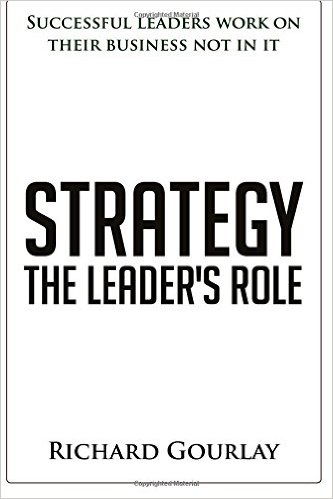
Strategy The Leader's Role by Richard Gourlay

Leadership in business is a challenge we can help with.

Have you felt the full power of the Internet Tsunami Yet?

Has the world moved for you, or did you miss it? The world of business has shifted but many businesses don’t seem to have noticed the great shift in power away from companies to the customer. The internet is not a fixed service, it is growing and evolving rapidly and with it so are the tools and uses it delivers. What was once a way to replace your Yellow Pages has become the most powerful source of information the world has ever seen.  Have you felt the full power of the internet tsunami yet?
We all see the impact of the Internet in every market sector.  We see the growth of online shopping or the growth of smart phones and the online move of insurance and music online.  That shift and the corresponding growths of new consumers are just beginning to be understood, this is just the proverbial tip of the iceberg. The next stage of the internet revolution has yet to be felt.

The Great Paradigm Shift: Internet Tsunami

As our understanding of this shifting paradigm slowly emerges and evolves.  It takes time for its impact to be fully understood and its impacts to be really appreciated. In the same way as the impact of the introduction of domestic electricity which subsequently facilitated the introduction of the radio, which spread communication did in previous generations. So the rise in power of the Internet is more than just our ability to look stuff up and buy consumer goods online.
This paradigm shift has certain key features, which makes the rise of the Internet generation far more dramatic in its impact to business today.
Unlike many previous innovations, the move online has been done in an infinitely scalable way.  Making markets financially accessible to company’s of any size and dimension using low cost everyday technology. The whole plethora of internet software platforms provide total engagement opportunities for businesses to reach specialist or global markets. Rather than being a premium service only open to the super rich, such as the introduction of the car, airline or a global consumer product range. A good idea, service or product can now be provided through the internet instantly. The availability of multiple open software technology platforms, has lowered cost and created universal access by braking down barriers across all areas of a global market.

The Internet is a Global Movement

This global shift, supported by governments and industry to reach and penetrate all and every strata of society and on an almost global reach is a new global phenomenon creating a universal shift.
Whether in New Guinea or Newfoundland, you can get a 3G signal.  Many countries like India and China just leapfrogged the copper wire landline systems of the 20th century through large parts of their country’s moving straight into the 21st century, avoiding unnecessary cost and rapidly accelerating progress throughout their country.  The Arab spring was not achieved by any three letter acronym news agency or Rupert Murdock’s media empire, but by new young mobile online generation who created, sustained and drove the rolling revolutions.

The POWER of the Internet Tsunami

The result of the internet revolution is that the world has made a huge step forward almost overnight.  That has changed more than just the way we buy some products, it has in fact changed the way we think, and act.  This universal overnight movement has also solved the adoption dilemma for new technology.  For companies to achieve a launch of a new product or service they had to achieve a critical volume and this can now be achieved without geographic boundaries.  The internet creates multiple new routes to market, bypassing traditional routes to market, achieving profit without having to invest huge amounts of capital in awareness marketing.
The sign you've been looking for that values matter in business

Internet Empowered Intelligence

This paradigm shift has moved the way we think to such an extent that everything has changed. When in 1906 Admiral Sir John Fisher invented the Dreadnought battleship in 1906, he changed naval world overnight. At the time the Royal navy had 1,000 ships of the line, the introduction of the Dreadnought made them all redundant overnight. Suddenly, to be a superpower it was not the number of ships you had but how many Dreadnoughts you had and a new arms race had begun as every other battleship become redundant.
In the same way, the introduction of always available high speed broadband has made so much of business thinking redundant, not just in the collapse of use of directories such as yellow pages, dictionaries or our communication. Today people have empowered intelligence, the ability to become informed by scanning a QR code, or connecting to a highly rated source they can become more than informed, they can become actively empowered.

Internet Tsunami Continually Evolves 

The internet is now driving people to think and do things in different ways across many age and economic cohorts. Its not just the young buying music or consumers doing their shopping online, although both have delivered huge shifts in culture to these markets.  People’s first mental response to knowledge and decision making is now to click, look-up and become informed.
No-longer relying on our embedded historical mental heritage or through experts’ advice, people are now researching and networking their knowledge and our learning, widening knowledge and creating expert communities on almost every subject matter possible. For example to become an expert on social media you could do an online course or you could click onto Mashable and become an expert within hours. Anyone and everyone can become an expert, exposing consumer and business choice to new forces and opportunities.
You may have heard the old adage that there is more computer power in a simple watch today than on the Apollo 11 spacecraft which took man to the moon. People have at their finger tips more knowledge about companies than even the most informed company is aware off. Users groups, expert forums and review sites empower and drive decisions, in a far more effective way than traditional marketing channels can persuade customers.
In just in the same way that the Arctic Monkeys pioneered the music online community following, rather than through the plugging and playlist approval to get on the radio. Today the same today is true of consumer both in consumer and business markets.
The power of the internet is yet to be fully understood. For some it has been like a Tsunami, just as a record shop or an insurance salesman. To many others though it is an unseen force, they know its there but not what or how it operates and effects their business. But it is and it will. The sooner business wakes up to these changes the better placed they will be to compete without feeling they have one hand behind their back.
Vision to make change n business by Richard Gourlay

A good business has clear objectives and goals to achieve.

For leadership teams planning a business is focused around the annual exercise of business planning.  Reviewing what went well and what did not, reviewing the overall performance of the organisation, its profits (or losses) and deciding what to do differently and what to keep the same for the forthcoming year. That’s why a good business has clear objectives and goals to achieve.
One key area which good leadership teams consistently get right is in rolling out the right measures, both soft and hard measures of performance inside a business plan. Cascading business plan objectives down to department and down to personal performance objectives are the vital element in implementing a business plan successfully. The key ones include refreshing the vision and connecting clear objectives and soft and hard metrics together to all levels of the organisation.

Business Goals

Having a vision is vital to be successful in the long term, but having objectives will ensure you get you there. Clear milestones for everyone inside your company, top to bottom are the essential component of a successful company. Every successful company has clear goals, strategic ones the outrageous ones (global domination) through to achievable tactical objectives.

Without clear (SMART, see below) objectives a company will loose focus on its goals. Poor or non-specific objectives companies can fall victim to strategic drift, this month’s whim and next month’s quick idea.  The failure to cascaded objectives at every level allows good people’s morale and confidence to fall. This is because they cannot see where how they are contributing to the company’s success. Everyone should know how they contribute to the business plan’s success. Failing to set clear objectives in a business plan creates a path to failure in execution and devalues the process of business planning and it becomes a waste of paper, time and effort.

Business Objectives

Objectives should be like a pyramid, with the big objectives at the top, but at every layer underneath there should be the sub objectives that make the bigger one happen. A well run organisation should therefore look like a pyramid, in terms of objectives, with everyone working on their goals which build up together to achieve the big picture goals. This form of management managing by objectives MBO, (not to be confused with a management buy-out MBO), allows people to focus on their objectives, which are aligned to higher goals.
Try not to have too many objectives to achieve. I always recommend no more than 5 per person. The reason why 5? Because it keeps people focused and not drowned in statistics. Even at the company level remember the old KISS concept of simplicity, if you have page after page of objectives some will suffer unless you can resource them. Focus on what really matters to the business, what drives performance and how are they made up. For people think about their Key Performance Indicators, KPI’s they are doing a good job if… Classical KPI’s usually include: revenue, margin, customer numbers, retention, growth, production, saving, are amongst the most common.

Setting Business Objectives

High performance companies often drive all their goals by setting team objectives which are then broken down into Key Performance Indicators (KPIs) for each individual employee. Try not to give any individual or manager too many. An easy way to achieve that is to ensure they can remember and recall them with ease when you meet them.

The benefits of setting good objectives:

1.       Objectives define the entire purpose of your business (or unit) in a couple of sentences or bullet points or set of numbers.
2.       Objectives are often identified as key performance indicators at the individual persons performance.
3.       The objectives that you set determine the quality of the strategy or tactics that you will adopt.
4.       Goals allow leaders to Manage By Objectives MBO. This avoids time in argument and also helps in introducing a more participative management culture where employees are encouraged to set their own objectives.
5.       Clear KPI’s per person is a successful way to evaluate performance as long as the KPI’s are numerate or translatable into a numerate language.
Remember SMART criteria to define attributes of good objectives:
That is:
·         Specific
·         Measurable
·         Achievable
·         Realistic
·         Timely

Achievable Goals

If goals and objectives are not SMART then they are unlikely to be achievable.  Being better or good for example is too often quoted as a goal or objective, and while that is a statement of direction it is not a clear viable goal or objective. SMART goals and objectives are tangible they are a defined quantifiable number or a supported qualitative measure compared to an existing one.
Goals must be achievable. But for that to happen they must be quantifiable, either numerate or benchmarked compared to a previous number and deliverable within the timeframe to the standard required.

SMART criteria include:
1.       Both short range and long range targets should be set.
2.       Both quantitative and qualitative
3.       Clear. Put them in writing, to be achieved within a specified time frame.
4.       Measurable. So that they can be compared with actual results.
5.       Challenging. This is so that staff will put greater effort and be more motivated.
6.       Achievable. Avoid overly optimistic goals as this might be counter productive due to their demotivating nature.
Goals should be realistic, reasonable, reachable and beatable. Avoid hidden goals and don’t be over specific.
Hope that gets you thinking? Want to learn more then contact us or click here