Growth planning in business

Turnaround Your Business: The Garden Rooms Case Study

Case Study a Garden Rooms business in Scotland

Turnaround Your Business with Richard Gourlay

A Garden Room

Turnaround Your Business

The owner of a Garden Rooms business in Scotland approached me to turnaround his business. Operating in a potentially growing market designing home garden rooms, such as offices, bedrooms and gyms while also still building home extensions. He was struggling to run these businesses, spending most time running around firefighting and dealing with unhappy customers. To turnaround your business often external advice and active support is essential, here’s why.

The Situation

The owner was trying to run too much at the same time, which put him under: –

  • Financial pressures: no real financial model and limited systems in place. With little cost management or operating and margins in place, putting continual pressure of the business’s finances and margin impacts. 
  • Operational issues: with no operating systems in place each project ran differently, which lead to a wide range of quality and complaint issues, including legal disputes.
  • Quality issues: with staff firefighting onsite with suppliers to get components to site on time, impacting upon delivery times, production and cost and quality impacts.
  • People issues: of unhappy and unmotivated staff, no one really knowing what they were being asked to do and good staff leaving. 
  • Ultimately there was little customer focus and significant firefighting, unfinished jobs with a long list of snagging issues to be resolved.

Our Solution

Working with the key people we developed a clear business strategy and culture shift for the business, identifying the businesses core value proposition and a customer focused ethos.

This led to a complete process of change and focused team actions to re-invent the business around its core value proposition and improvement plans to redesign out all root cause issues within the business. 

Following this process we then developed a customer process map.  This identified every customer value added step and supported the customer through the entire process. With a new marketing strategy also in place we were able to improve: –

  • Customer engagement and acquisition which led to an improved Average Order Value (AOV) of 55% in one year.
  • Ownership of issues by frontline staff to get it right for the customer, reducing snagging and issues to a controlled minimum, with everyone pulling together.
  • The development of product improvement and a full product range to support customer retention and conversion, making the business the dominant player within the target market.

This Enabled

We worked with the owner developing his business and his skills to lead his business more successfully, providing support and guidance throughout. This was supported by clear business planning with the owner with a full strategic and operational business plan in place. 

  • Clear success goals shared with the team. 
  • A forward annual business plan covering every aspect of the business. 
  • Sales goal setting which supported and underpinned the financial plan.
  • A comprehensive financial and cashflow model to ensure the business is cash positive and profitable for the first time.
  • The owner was able to positively look at a trade exit strategy from this business. 

Turnaround Your Business

Revitalising, recreating or jest evolving your business is an essential requirement to become and keep being competitive within your market. Don’t wait until it is too late. The earlier a business leader identifies they could benefit from a strategic refresh the more options and quicker positive change can happen. To turnaround your business with Richard Gourlay then lets have a chat with Richard here now.

Great brand by Richard Gourlay leadership and strategy

What makes a great BRAND

What makes a great BRAND?

Despite what marketing people passionately believe most people don’t think about brands, they just get on with their lives. The coffee they buy, the supermarket they go to and petrol station they visit happen almost by accident. In Britain today we are too busy to think through these everyday inconsequential purchases, focused on saving time, not forgetting something or rushing from place to place on a tight deadline. So do brands matter as much as they used to and if so why and how?  Brands matter where consumers can value them.  In today’s wealthy world every product or service perceives itself as a brand, even if it is just a label. So what makes a great brand?

Consumer Choice 

Let’s start with the basics, the consumer has choices. Endless choices if they choose to use them. But in many everyday cases as in my examples above, the consumer sacrifices those choices for simple expedience. The inability to see (or value) brand differentiation, between Starbucks and Costa, between Tesco and Morrisons between BP and Shell, and yet they each fight for space in consumers minds through tiny differences which if we stop and think about do actually exist and we the consumer do actively value.

So much more than First Impressions 

So in today’s Britain, what is important about a brand? Is it the halo effect, the first impression, like the smile on the front of a car or is it something more, something deeper and more tangible? Ask the owners of Sunny D (the 90’s orange juice lookalike) and you will find that the halo effect does not last if your brand is not true to itself and to its consumers. Customers have to believe in a brand, it must tell the truth, be transparent and honest if it is to be successful. Gerald Ratner (former MD of Ratners the jewellers who said about his products “because it’s total crap”) also found out that in today’s world everyone must truly believe in the brand, not just the marketing department but the whole company has to believe it and most importantly practice the brands beliefs.

Clear Brand Strategy 

Being clear and precise is also important in the company’s messages for a brand to succeed, a strong undiluted brand message must enthuse internally but must also consistently connect with customers through touch points, look at Innocent, Dorset Cereals or Apple as classic examples of touch point. They also demonstrate a clear story delivered with passion about who they are what they do and why they matter. This focused and consistent message is not just a marketing message but an ingrained set of values which consumers buy into with passion. These brands not only position themselves as premium players in their fields and earn more but they also continuously find new ways to spread their key messages to customers, they have a clear brand strategy to achieve it.

Everyone Lives the Brand

Another vital aspect of any brand success is that the people within that brand demonstrate what they preach, they live that lifestyle, support that brand and contribute to its success. It is their lifestyle, it is a part of the way they and their brand do business.

Great brands go beyond the brand to understand its real value to existing customers but also to tomorrow’s customers.  Whether it is a family run local shop or a global supermarket chain great brands position themselves so they develop and hold a market position to develop long-term success.

Vision and Purpose

Great brands create, sustain and evangelise a culture which supports and drives their brand. Creating a culture which underpins an organisations vision and purpose is a key prerequisite for ensuring sustainability of a great brand. Sustainability of a vision can only be achieved if the organisation is supported by an underlying culture which fits with the brands ethos.

Great brands can only transpose from the innovative visionary founder if they create a supportive culture to sustain the brand. An effective and appropriate culture is one which supports the brand and ensures it is can sustain its market position over time.  Great brands sustain themselves through a great culture.

The culture of a brand, otherwise seen as the handwriting of the organisation, enables sustainability of the brand over time. Culture today matters from how people work together through to acquisition of appropriate talent. The right people are drawn to a brand they aspire to be part. Business partners focus on brands with likeminded cultures andante to be part of a great brand. In the exact same way customers aspire to be associated with a great brand.

Great Brands are not Labels

Great brands drive markets. By challenging them through innovation and changing perceptions. Labels on the other hand feed off brands by picking of successful innovations for downstream ‘me too’ market following customers. Great brands invest high proportions of their resources in driving markets forward, through innovative products and services. Great brands are seen to out invest other players more double the the market average.

Creating innovative pipeline cultures thinking long-term make positions rather than short-term tactical single product successes. Labels focus on creating  market winning season products, they act as followers often being low-cost alternatives to the brand leaders in any sector.  Brands focus on the longterm innovation which shift the paradigm of relationship with the customer through the brand.

Great Brands Add Value

Great brands also develop their own uniqueness, not just the product or service but the whole package is how we do it around here. There needs to be not only consistency but the brand hand writing and value on how they do it. The best brands always develop singular simple signals for customers, cutting through jargon to create clarity without patronisation.

For brands to succeed in today’s global markets these golden rules have never been more important as consumers have never had so much information, but if you follow these simple rules of brand success you can develop and maintain a great brand.

Looking for Advice  

If you want to develop your company’s brand and are looking for some advice on developing your company, its marketing, its sustainable competitive advantage then contact us at Cowden  to see how we can assist you, or read more about us in this blog or at Cowden

Click below to follow Richard Gourlay on other social media:-

Website – Linked in – Twitter – Facebook – Blog

Cowden Consulting is a strategic planning and implementation business which works in partnership with customers to grow and develop their business, contact us to learn more.

Posted 1st December 2011 by Richard Gourlay

Location: Old Glenstocken, Colvend, Stewarty of Kirkcudbright, Galloway

Labels: brand brand identity brand strategy brand strength branding business success marketing strategy strategic direction strategy sustainable companies values vision

Leadership Development by Richard Gourlay

Great LEADERSHIP starts with your VISION

Great LEADERSHIP starts with your VISION 

Having a Vision for your business is the most important leadership trait for a successful leader to have. For leaders to lead they must have a strategic vision for their business. A clear future state they want to achieve. One which provides not only an optimum place within their market they want to be; but one which inspires, motivates and drives the organisation to achieve. Heres is why Great leadership starts with your vision.

Great leaders may be charismatic, they may even be likeable, but for them to be successful they must be able to communicate and inspire others through their vision. A vision is a future place within tomorrow’s market.

Leadership Vision

Leader’s must create a vision which is not only aspirational for themselves but motivational for the all stakeholders.

A recent survey of 1,439 chief executives and senior HR people from 707 organizations across the globe, found that the outstanding trait of successful leadership is the ability to create and communicate a VISION.

This is the single most important characteristic for success.  Amongst those interviewed a clear vision scored an impressive 92% amongst such high level people in business. This demonstrates just how important a characteristic this is in creating a successful leader.

Vision to make change in business by Richard Gourlay in this article: Great LEADERSHIP starts with your VISION


“Without a clear vision no leader can succeed today in business”

Creating a VISION

Creating a vision is not easy. Leaders are busy people fighting to keep their business on track, dealing with day-to-day issues and making decisions based upon facts and figures. That last point is therefore a real challenge for leaders in developing a vision. This is because there are no facts and figures about the future. The future, by definition is unknown. Instead leaders must rely upon a range of forecasting tools, from gut feel or by benchmarking agianst others, to develop their vision of what the future might look like.

Each of these options in forecasting the future are fraught with danger and risk. Both in terms of making decisions based upon inaccurate perceptions or the damage to their credibility as a leader. Following others through benchmarking is always the safest option for leaders. But this limits leaders to be a follower within any market sector, rather than to lead it from the front in their sector.

Great Leadership deals with Change

For leaders to lead, they must be able to deal with change. Change happens in-perceivably until it is obvious. Every day we grow older but it is only when we look back we see how we have aged. The same is true for a business in any market. Even when change is driven by disruptive new entrants, the change that enables new players to enter a market is caused by subtle sometimes in-perceptivable changes within a market. Change is everything and is happening all the time.  Subtle innocuous and minor alterations in a market can become future key drivers of change which create new opportunities are areas which leaders need to keep aware of and proactively respond too.

Change is the only constant in any business. The market is always moving either through Macro market factors or through Micro market factors. Good leaders need to be continually scanning and monitoring both and assessing likely positive and negative  impacts upon their business, their customers and their channels to market and value perceptions of their brand.

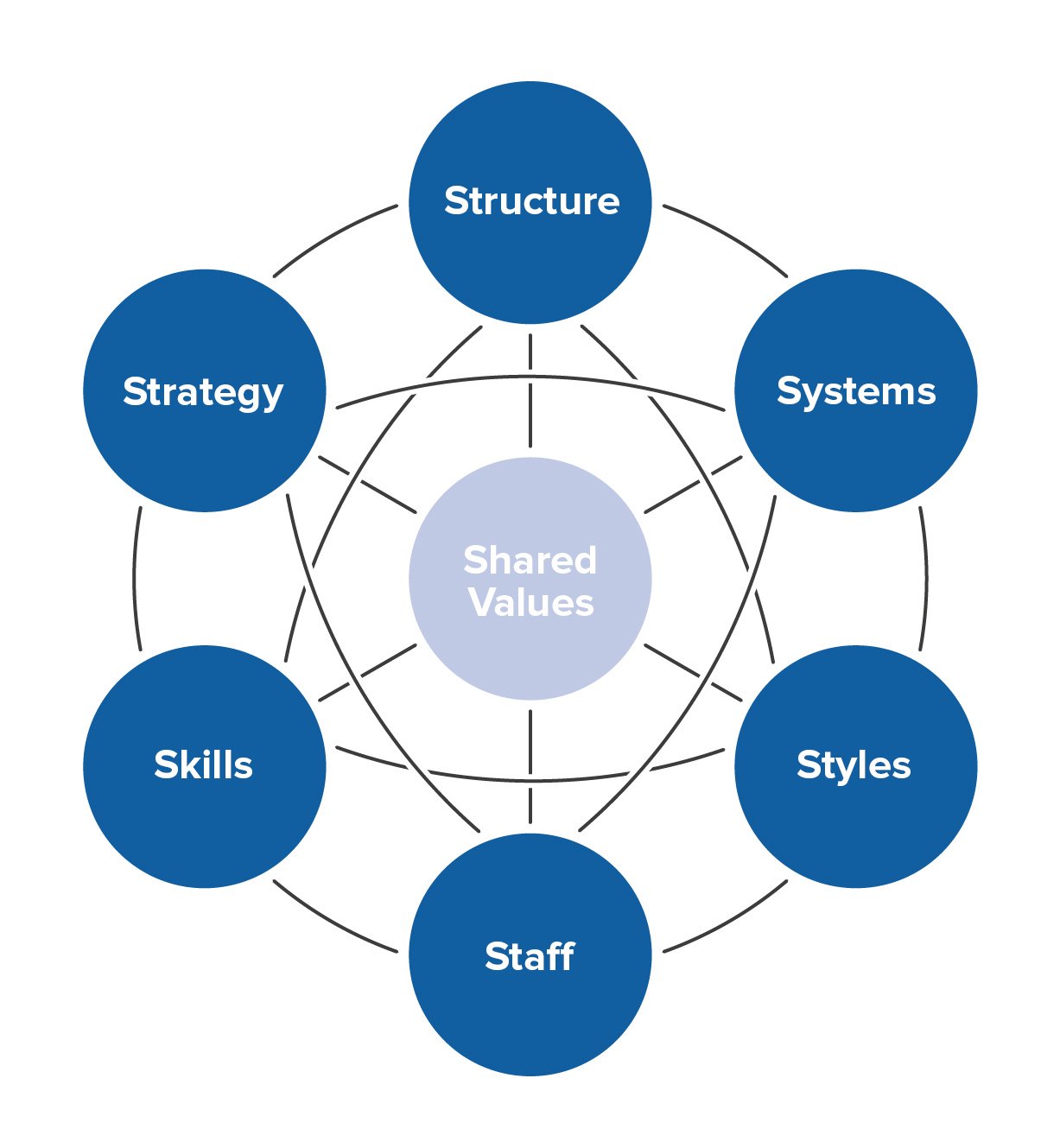
Great LEADERSHIP starts with your VISION using McKinsey7-S-Model to assess a company structure for leaders by Richard Gourlay

Challenges for Leaders Vision

Failing to validate and then alter a business model to reflect changes in the market towards the delivery of a vision. This is the single biggest single reason chief executives fail to succeed. 

Leaders have to carry people with them for their vision to be live. Poor communication skills are at the heart of why visions and therefore leaders fail to succeed. Leaders must be able to create, verbalise and rationalise to others their vision to generate buy-in and carry their senior people with them. Being able to visualise their vision and communicate it to a wide range of stakeholders often stalls or causes failure in strategy delivery.

For a vision to succeed leaders have to build relationships. This starts in developing trust in their future and develop a team culture all working towards that vision. The inability for leaders to invest in developing their vision often results in the lack of trust and development within the senior team.  This failure to develop leadership soft skills, is a major area leaders must invest in to improve their effectiveness as a leader.

Leadership is both Science and Art

Leadership is a balance between science and art. Creating a vision is often seen as an art, but for a vision to connect with senior stakeholders visions require a scientific rationale. It is the old adage we buy with the heart and justify with our head. A solid vision is both a visual message but one backed up with both direct and indirect evidence of that future state in which the leader’s vision sits. A successful vision pulls people together through shred valued values across the organisation what creates and sustains those values.

Great Leadership requires Communication Skills

The importance of being financial and operationally literate to the CEO role is always seen as core leadership skills. These hard skills are often key drivers of leadership assessment. Which is why so many CEO’s come from finance and operations leadership backgrounds. Today these competencies are seen as important for any CEO role.

In todays’ business environment CEO’s are being selected based upon having a demonstrated track record of delivering strategic vision. The ability to inspire others through delivering a strategic vision is now being seen as the most important track record for successful leadership.

Succession Planning 

The importance of succession and smooth transition is becoming more important element for successful leadership. Companies today are investing time and effort in succession planning. Well planned succession planning ensures long-term shareholder value and the ability of avoiding the football management culture of overnight change. Poor leadership choice often leads to cultural conflict and short-term reactionary thinking leads to rapid and unsustainable change. Both these mentalities damage the long-term sustainability of a successful business.  The leadership teams ability to develop successors who are able to support and follow through a vision is becoming an integral part of the CEO role.

Business leaders all recognise that talent management plans, including succession management have become essential for sustained performance in today’s organisations.

If you want to develop your company’s position then there needs to be a clear vision for it. Vitally answering the questions where it is going and why? If your are looking for some advice on developing your company, its marketing, its sustainable competitive advantage then contact us at Cowden.  Let us see how we can assist you, or read more about us in this blog or at Cowden.

Or learn how to plan your business successfully see our video to learn more:-  http://www.richardgourlay.com

Click below to follow us on other social media:-

Website – Linked in – Twitter – Facebook – Blog

Or buy the book on strategy here: Strategy The Leader’s Role 

Strategy The Leader's Role by Richard Gourlay

Cowden is a strategic planning and implementation business which enables customers to grow and develop their business.

What Matters In Business For Successful Start-Ups?

What makes a successful company in a market? Is probably the single biggest question a new start-up team must be able to answer. What factors make a successful business has always been a difficult question to answer. So what matters In business for successful start-ups?

The answer has always depended upon who is asking the question!

Unicorn Start-Ups

Dreamers look for unicorns with unique protectable offerings, such as Intellectual Protectable rights, a Unique Selling Proposition (USP).  These dreamers will invest in big step start-ups, market disrupters which will change the markets they wish to operate within. Step changing start-ups such as unicorns (are rare hence the name unicorn), but can reshape markets towards these start-ups. Think about Apple and Amazon and what they have done to the markets they operate within. Today these two are the largest (by value) companies in the world today.  

Unicorns need a unique angle, a technical platform angle, a defendable IP, or a unique (and defendable) operating platform. Even small start-ups can be unicorns if they can identify and control a unique position. Inside Apple’s early technologies was the British made ARM microchip, which propelled it into be a unicorn.  But unicorns are rare, and their window to get established is getting shorter and shorter as competitor awareness and responsiveness is constantly quickening.


Funding Start-Ups 

Traditional funders, such as banks want high returns with low risks, and owners who will take all the risk directly, or being prepared to 100% underwrite the banks so called investment.  Banks do not like, or take risks, which is uncertainty.  Which is why they avoid taking them, unsecured risks are not what banks generally do. So they may support a start-up with a loan based upon a sensible fully costed and robust business plan. 

Banks, who are most start-ups first point of call, often provide a poor place for people to start a conversation with about a business start-up. Start-ups looking for financial support, ideas and how to get a business start-up off the ground often left disappointed by the support which they receive.   

The risk reduction by definition reduces opportunity; in essence if you remove all the risk you also remove all the opportunity a start-up can achieve.  Start-ups often overstate their growth, understate competitor defensive activity and the challenges in getting established. Often start-ups can find better funding through self-funding options, alongside friends and family as stage one seed funding.  It is always best to start small, prove your concept and then go out to market for stage 2 funding with a proven pilot under your belt.  

Start-Up Entrepreneurs Solve Customers Problems

Entrepreneurs genuinely look at solving an emerging problem, the old adage is:-

“The secret of success is to find a need and fill it, to find a hurt and heal it, to find somebody with a problem and offer to help solve it.” – Robert H. Schuller

While the logical approach of bankers is to ride an existing market wave, true entrepreneurs look to create the wave. They are looking at a problem and identifying the ideal innovative solution for that problem’s resolution.


Researching Successful Businesses

So what makes a successful business model includes a whole variety of factors including the core idea, the experienced team, the market opportunity, market access, competition, scalability (the list goes on and on, depending upon who you are talking with) and what resonates with key stakeholders and target audiences.

Recently Bill Gross, CEO of Idealab decided to research this using his extensive range of business start-ups; 100 of his own, and matched by another 100, across a whole range of sectors.  His assessment started by analysing what makes successful businesses. He came across 5 key common factors and he cross-referenced those compared to businesses which have succeeded.

Bill Cross’s 5 keys for a successful business include:-

  1. The Idea: defined and coherent.
  2. The Team:  skills, experience, energy and how well connected.
  3. The Business Model:  comprehensive worked through covering the business need.
  4. The Funding – access to the right amount of money to achieve its core goals.
  5. The Timing – identifying the market timing to meet target audience needs.

The research results contradicted what many thought would be the results across the 200 companies he and his team analysed. This survey included global names such as Airbnb, Youtube and LinkedIn amongst the 200. His analysis showed that of all the factors which can affect success or otherwise of a business, success really came down to these few key ones. They key factors which are common across all markets, sectors and over time  are the defining characteristics for a successful business. But of all the factors one stood out throughout the survey.

Success in Business Start-Ups Relies Upon…

Timing is THE common factor in a successful business at 42%. It is the most common trait of successful company start-ups.

Team came in 2nd, with 32% and the Idea only came 3rd in importance with 28%.  The business model, upon which so many advisors focus their attention was 4th at 24% and the funding came in 5th at 14%.

Timing Is Everything for Start-Ups

The quality fo the idea is not as important as timing. Timing, the driving strategic factor can be identified initially through a thorough PESTEL analysis. Timing is the bottomline performance criteria in driving the success factor for a business.  PESTEL factors set the macro landscape a business operates and defines the timing of its launch. If the landscape is favourable then a business can succeed. I not, then even if everything else looks great then your chances are far lower, than if you get your timing right.

This shift from build and they will come, the old motto of every good idea, qualifies that statement by saying if the time is right then if you build it they will come.

What Matters in Business for Start-Up Success is therefore Timing

If you look at all  successful business over time, then it is always timing that matters. Knowing what to do when really matters for leaders to focus on. The world is full of ideas launched at the wrong time. But get your timing right and the world is your oyster.

From the launch of the internet and the creation of Apple, to the development of low cost airplanes to the launch of low cost holidays, timing is everything. 

The Importance of Research for Start-Up Leadership Teams is Vital

Leadership teams need to focus on answering the question their target customers ask, now. Timing is offering the solution the their customers will pay for today, not waiting for it or putting up with second best. If you can answer their needs when they need it, with what they need, then you are on the first rung to find success. Without good timing you are creating products and services no-one (or not enough people want). Timing is equally important for leadership teams to assess if your product / service can be accessed by the target audience.

Successful companies work with their markets to get their timing right in launching products and services that fit within a market. They can challenge existing customers perceptions but they must be the right product at the right time for the right customer if a business is to succeed.

See Bill Gross, CEO of Idealab Ted talk here:-

https://www.ted.com/talks/bill_gross_the_single_biggest_reason_why_startups_succeed

Like to know how Richard Gourlay can support your business to succeed, then contact Richard here or below.