Director Mentoring 6 Great Reasons to Be Mentored by Richard Gourlay

Richard Gourlay Director Mentoring

Being focused and clear on where you are going is vital as a director. Clarity of direction with a clear focus with your business puts leaders in control of their business.  Being in control ultimately ensures leaders are successful. But taking control is one of the biggest issues leaders face. Knowing where to start, and even how to start making positive changes to your business can be a real challenge.

Leaders Mentoring Needs

Successful directors must be able to create and make change happen. Making change is essential to make their company able to meet demands and expectations of its customers. So leaders must become change makers within their organisation to make it and keep it successful. Knowing how and when to make what changes is the many skills which leaders need to develop.  Being able to see the need, communicate it and deliver change is a major skillset senior people need to develop.  Leaders have to be able to move outside their existing comfort zone in taking people through change..  

Successful change makes a real bottom-line difference to your business success. But to go through change is often painful and difficult. This is where an experienced mentor makes a real difference.

A good mentor is someone who has not only been through change several times, but someone who also has seen it across multiple markets and with different types of people. A good mentor gets to know you as a person and gets to understand the real challenges the mentees are facing.  That’s why leaders find mentors who support them achieve their goals.  Richard Gourlay has been mentoring leaders for over thirty years. 


The difference between Telling Mentoring and Coaching

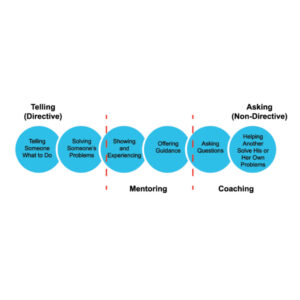
Mentoring is the process which supports leaders develop their skills by working with them in developing the mentees skills. Mentoring is a specific set of development skills where a mentor shares their knowledge, skills and/or experience, to help another to develop and grow. 

To see how mentoring sits between telling and coaching, see the graphic below. Mentoring is more effective than telling as it enables leaders to develop their skills through their real-life experiences. By talking through situations leaders learn and develop their skills, rather than being told what to do. Coaching on the other hand walks people through situations and provides guidance on specific issues. The greta advantage of mentoring is therefore that the mentee learns how to deal with business challenges  rather than being coached through situations. Why mentoring works for leaders by Richard GourlayAbout Richard Gourlay Mentor
Over the last 30 years I’ve worked with hundreds of business owners. Working with micro-businesses through to international PLC’s and I’ve identified that there are some key common factors that successful leaders do which ensure their success, while other business owners struggle to keep their heads above water. What I’ve learnt is that there are simple and logical steps that successful people undertake. These steps which make that something different in what they do delivers real results in taking the guess work out of their business success. This is the basis of effective mentoring. 

I’ve spent years refining those key steps into a programmes of business mentoring for senior people. My mentoring programmes  support personal growth. Mentoring creates bite-size action planning that develop people in their role. My director mentoring programmes enable people to develop their personal and professional skills. We develop key outcomes into sessions which develop a clear programme of development. Each programme starts by identifying mentees core strengths and areas to work on. This is then developed into a bespoke plan of what they need to do differently to be even more successful in their role. 

My Director mentoring programme

Taking the guesswork out our business success requires people making simple steps over time.  Mentoring support is usually a monthly process of development.  Each step is small and measured, typically spread over a monthly. People are held to account to make the change they want to see. By making each step happen leaders grow themselves and their team as their confidence and competence grows. Our bespoke programmes enable business owners to work ON their business effectively rather than just spending more time IN their business.

Below are some of the key things to consider in taking the guess work out of your business success:-

1. Mentoring: Know What to Work ON

Knowing what you need to focus on makes a huge difference in where to invest your energy and resources. I’m a huge fan of the leadership culture of working ON it not IN it.  If you are not working ON your business then how is it going to improve?  It is the leader who must make the business stronger.

How will you, or your business be ready and able to face tomorrow’s challenges without making change happen?  But you need to know what is important to work on within your business, and why!   That’s where mentoring supports you grown and develop as a leader. 

2. Directors: Why you are working ON your business

The only certainty in business is Change. Today that has never been truer. The pace of change in every market has, is, and will change at an ever faster rate. Changing market conditions, to customer demands, through to employee expectations have all created additional extra pressures on leaders to respond quicker. Accelerated changes within the business environment require leaders to adapt quicker and more effectively.

How should you respond to those changes?  Fast enough and effectively enough to take full advantage of those changes, without loosing site of where you are going and why. If making change is a challenge or if you have ever wondered how to make positive changes, then my mentoring programme will enable you to understand why and how to make change happen. Working on your business is the most valuable actively any leader can undertake and  puts you in the driving seat of your business.

3. Director Mentoring: Where to Grow

Every business owner wants to grow turnover, profitability or customer base, but how is the important question. Where is tomorrow’s growth coming from and how can you access it effectively and efficiently? This step-by-step mentoring programme will show you where growth is going to come from and how you can effectively access it.

What is good profitable growth rather than just growth. An important distinction which leaders need to recognise that all growth is not good.

4. How to Make Change Happen

Doing what we’ve always done is the natural default behaviour that people fall back into despite best intentions. Change does not happen unless you make change happen. Mentoring, working with an external advisor is an effective way to develop yourself offline from your existing line management structure. Being able to discuss personal skills development with an external mentor allows people a “safe space” to bounce ideas around, share frustrations and concerns enables people to think through making change happen.  

Change is always easy to talk about, but harder to actually deliver. Change is always necessary to achieve success. This step-by-step mentoring programme enables you to create the right changes, which deliver the right results for success. Every step involves a single simple activity which is supported by a template in a workbook to create your success.


5. Director mentoring Reduce the Risks

Taking your business from where it is today to where you want it to be tomorrow is essential to keep your business competitive and successful. But change involves taking risk, but there is an even bigger risk in not making change. Director mentoring programmes reduce these risks by evaluating and balancing the risk factors effectively.  Each step is focused around making sensible pro-active decisions which have been tried and tested.   

Being mentored by an experienced independent director allows you to talk through ideas and thoughts with a neutral advisor . An experienced mentor provides a sounding board for director decision making and will challenge your assumptions prior to you making a decision. This reduces risk and allows a director to talk through scenarios and likely consequences. This puts risk reduction and mitigation in place to manage and overcome those risks.  Being mentored therefore provides confidence and certainty in decision-making. 

Richard Gourlay is an approved MentorsMe mentor, click link to see Richard Gourlay MentorsMe 


6. Director Mentoring Effective Way to Grow 

Taking the risk out of your business success is all about taking small, simple but highly effective steps. Steps, sometimes small, but always forward move the business in the direction you want it to go.  I have designed personalised mentoring programmes to fit every type of person and business by size and sector and at every stage of its development.

Short bite size learning, on face to face or remote sessions support leaders lead successfully. I design a mentoring format with clear models (including  templates) suitable to each leaders specific needs. I then bespoke design it to enable you to achieve your success. Supporting your personalised mentoring programme are emails to help support you undertake each step and keep you on track. 

So if you want to take the guesswork out of your business success? Then this effective mentoring programme is specifically designed for business owners from start-ups to established businesses owners to take the guess work out of your business success.  Our mentoring programmes are a combination of online and face-2-face, depending upon your needs and location.

So get started today, make the first step and contact Richard Gourlay today to start your mentoring journey, just fill in the form below. 
SaaS Business make you own path by Richard Gourlay

How Steve Jobs changed the World

Strategy: How Steve Jobs changes teh world by Richard Gourlay

Apple’s founder and talisman, Steve Jobs has finally had to step down from running the world’s most successful company.  It is probably overdue that the world recognises this brilliant strategist who changed the world.  Here’s how Steve Jobs changed the world.

Had Steve Jobs just set-up Apple he would have gone down in history as a great inventor.  But to have done it twice over with the same company, while in the process creating the world’s biggest company, surely makes him the greatest ever.  Possibly his most important contribution was that he created markets and then the best products possible for those new markets.  Steve Jobs understood that the technology needed to work for customers, rather than expect people to work the technology.   

A Brilliant Visionary

As a brilliant businessman and strategist, he more importantly created world class products and ran the company that delivered those products to market. Most superb inventors just invent, and most great directors’ focus on leading. To do both simultaneously to such a high standard is an outstanding achievement.

Steve Jobs is so unusual because he understands that great technology does not sell itself. That to have great technology you have to be passionate not only about what you produce, but also about the world in which your products exist.

Steve Jobs a brief history

  • 1976 started Apple with Stephen Wozniak to make and sell printed circuit boards
  • 1978 launched  a new disc drive which made the money to invest in whole computers
  • Launched the revolutionary Macintosh computer in 1984
  • Ousted from Apple in 1985 and returned after creating NeXT in 1996 which Apple bought
  • Created Pixar with $5 billion in box-office sales, sold for $7.4 to Disney in 1996
  • Created the i-generation with more to come such as iCloud and entering the TV market

While to many who did not understand his holistic strategy, they looked for and saw flaws. They tried to stab the ego and even removed him from his own company (to play safe with what he had produced as a single new product).  He played the long game recognising that the world would not be changed overnight. This was his strategic master-stoke.  He got the timing right by understanding the big picture and knowing when to strike.

A Difficult Man To Work With

He has been described by those who have worked with him as wilful, irascible, temperamental and stubborn, to name a few.  But can anyone do so much without at least those characteristics to change the world?  Other words, which people often use to describe him, include perfectionist, insistent and mesmerising. These words are the ones which the world will remember for. These drove him and describe how he has achieved such global success.

As a manager he had difficult dealings with many people at all levels, from investors and employees.  Management and human relationships was not Steve Jobs’ forte. These difficulties made him human. They were simple human failings which showed he was not perfect, but not issues which limited his vision or aspirations.

Steve Jobs Stanford Address

In his Stanford addresss (click here to see it here) in 2005 he explained what made him, drove him and continued to motivate him to become the person he was. This address is one of the few times he spoke of the huge success for which the world will remember him for.

Steve Jobs changed the world.

He saw a world revolution in technology before anyone else, and saw how he could drive that change. Great strategic thinking not only thinking about change, but also the impact of that change will have. That’s what makes him simply the best. Other owners and directors were working on improving their share price, or becoming number one with their new product. Focusing on the today, this month’s or this years priorities, not on changing the world. Steve Jobs looked beyond the single product to look at the whole picture of what a new world might look like.

Steve Jobs drove Apple to rethink the world and in doing so became its biggest player. His line in recruiting John Sculley from Pepsi “Do you want to sell sugar water for the rest of your life or do you want to come with me and change the world”. This sums up his strategic brilliance.

Steve Jobs Visionary

Evidence of this brilliant approach comes throughout his career. From using Vangelis’ Chariots of Fire music to launch the Macintosh, through to his unforgettable iPod launch where with a huge back screen shot he casually produced it from the back pocket of his jeans! Steve Jobs has learnt how to successfully engage with audiences. Every product is meticulously planned with product lined up to two years in advance, with innovative marketing from start to finish.

Moving From Technology to Retail

From a business which started out a just selling technology, it is now seen as having the best retail environment. That retail environment created places people actually want to visit.  Apple shops where the focus is on excellence, not on pedalling technology cheaper than the next retailer.

Steve Jobs has always had an eye for detail. His artistic flare turned geeky boxes into works of art. Steve want on a calligraphy course which led him to have a non standard font, Apple Garamond created rather than traditional New Roman Times font. Something he goaded Microsoft about at a high school speech some years later. That attention to detail is what demonstrated his perfectionist approach and left the competitors looking and feeling like they were in the dark ages.

Think Different Campaign

Apple’s “Think different” strategy has worked so well since 1997 because it touched people who felt there was no alternative to Bill Gates’ Microsoft monopoly of software. Think Different also drove change for both the 50,000 Apple employees and allowing his strategy to infect and spread globally.  It was not only technical people who bought into Macs but a whole new generation of users, who found that there was a credible alternative that did more than just be a glorified typewriter.

While Apple was never one man.  Steve Jobs legacy will be difficult to estimate for many years to come as the world’s most successful businessman. The old adage, it is not what one has done that counts but what one leaves to grow, that is the measure of a man’s success. It will take time for the world to see his true legacy, but the following puts some numbers behind this success.

Since Steve Jobs comeback in 1997 Apple has sold:-

  • 26 million iPhones
  • 60 million computers 
  • 200 million iPods
  • 1 billion iTunes songs   

Apple is currently valued at $356 billion ($2 Billion ahead of Exxon). Making it the largest company in the world. Last quarter alone Apple profits more than doubled to $7.3 billion. Sales rose by 82% to $28.6 billion by selling 20 million iPhones, 9 million iPads, 8 million iPods and 4 million Mac computers.

Steve Jobs announcement of his retirement wiped $17 billion *(5%) from its market share. But over his leadership he has increased its share value by 9000% since 1997.

What Matters In Business For Successful Start-Ups?

What makes a successful company in a market? Is probably the single biggest question a new start-up team must be able to answer. What factors make a successful business has always been a difficult question to answer. So what matters In business for successful start-ups?

The answer has always depended upon who is asking the question!

Unicorn Start-Ups

Dreamers look for unicorns with unique protectable offerings, such as Intellectual Protectable rights, a Unique Selling Proposition (USP).  These dreamers will invest in big step start-ups, market disrupters which will change the markets they wish to operate within. Step changing start-ups such as unicorns (are rare hence the name unicorn), but can reshape markets towards these start-ups. Think about Apple and Amazon and what they have done to the markets they operate within. Today these two are the largest (by value) companies in the world today.  

Unicorns need a unique angle, a technical platform angle, a defendable IP, or a unique (and defendable) operating platform. Even small start-ups can be unicorns if they can identify and control a unique position. Inside Apple’s early technologies was the British made ARM microchip, which propelled it into be a unicorn.  But unicorns are rare, and their window to get established is getting shorter and shorter as competitor awareness and responsiveness is constantly quickening.


Funding Start-Ups 

Traditional funders, such as banks want high returns with low risks, and owners who will take all the risk directly, or being prepared to 100% underwrite the banks so called investment.  Banks do not like, or take risks, which is uncertainty.  Which is why they avoid taking them, unsecured risks are not what banks generally do. So they may support a start-up with a loan based upon a sensible fully costed and robust business plan. 

Banks, who are most start-ups first point of call, often provide a poor place for people to start a conversation with about a business start-up. Start-ups looking for financial support, ideas and how to get a business start-up off the ground often left disappointed by the support which they receive.   

The risk reduction by definition reduces opportunity; in essence if you remove all the risk you also remove all the opportunity a start-up can achieve.  Start-ups often overstate their growth, understate competitor defensive activity and the challenges in getting established. Often start-ups can find better funding through self-funding options, alongside friends and family as stage one seed funding.  It is always best to start small, prove your concept and then go out to market for stage 2 funding with a proven pilot under your belt.  

Start-Up Entrepreneurs Solve Customers Problems

Entrepreneurs genuinely look at solving an emerging problem, the old adage is:-

“The secret of success is to find a need and fill it, to find a hurt and heal it, to find somebody with a problem and offer to help solve it.” – Robert H. Schuller

While the logical approach of bankers is to ride an existing market wave, true entrepreneurs look to create the wave. They are looking at a problem and identifying the ideal innovative solution for that problem’s resolution.


Researching Successful Businesses

So what makes a successful business model includes a whole variety of factors including the core idea, the experienced team, the market opportunity, market access, competition, scalability (the list goes on and on, depending upon who you are talking with) and what resonates with key stakeholders and target audiences.

Recently Bill Gross, CEO of Idealab decided to research this using his extensive range of business start-ups; 100 of his own, and matched by another 100, across a whole range of sectors.  His assessment started by analysing what makes successful businesses. He came across 5 key common factors and he cross-referenced those compared to businesses which have succeeded.

Bill Cross’s 5 keys for a successful business include:-

  1. The Idea: defined and coherent.
  2. The Team:  skills, experience, energy and how well connected.
  3. The Business Model:  comprehensive worked through covering the business need.
  4. The Funding – access to the right amount of money to achieve its core goals.
  5. The Timing – identifying the market timing to meet target audience needs.

The research results contradicted what many thought would be the results across the 200 companies he and his team analysed. This survey included global names such as Airbnb, Youtube and LinkedIn amongst the 200. His analysis showed that of all the factors which can affect success or otherwise of a business, success really came down to these few key ones. They key factors which are common across all markets, sectors and over time  are the defining characteristics for a successful business. But of all the factors one stood out throughout the survey.

Success in Business Start-Ups Relies Upon…

Timing is THE common factor in a successful business at 42%. It is the most common trait of successful company start-ups.

Team came in 2nd, with 32% and the Idea only came 3rd in importance with 28%.  The business model, upon which so many advisors focus their attention was 4th at 24% and the funding came in 5th at 14%.

Timing Is Everything for Start-Ups

The quality fo the idea is not as important as timing. Timing, the driving strategic factor can be identified initially through a thorough PESTEL analysis. Timing is the bottomline performance criteria in driving the success factor for a business.  PESTEL factors set the macro landscape a business operates and defines the timing of its launch. If the landscape is favourable then a business can succeed. I not, then even if everything else looks great then your chances are far lower, than if you get your timing right.

This shift from build and they will come, the old motto of every good idea, qualifies that statement by saying if the time is right then if you build it they will come.

What Matters in Business for Start-Up Success is therefore Timing

If you look at all  successful business over time, then it is always timing that matters. Knowing what to do when really matters for leaders to focus on. The world is full of ideas launched at the wrong time. But get your timing right and the world is your oyster.

From the launch of the internet and the creation of Apple, to the development of low cost airplanes to the launch of low cost holidays, timing is everything. 

The Importance of Research for Start-Up Leadership Teams is Vital

Leadership teams need to focus on answering the question their target customers ask, now. Timing is offering the solution the their customers will pay for today, not waiting for it or putting up with second best. If you can answer their needs when they need it, with what they need, then you are on the first rung to find success. Without good timing you are creating products and services no-one (or not enough people want). Timing is equally important for leadership teams to assess if your product / service can be accessed by the target audience.

Successful companies work with their markets to get their timing right in launching products and services that fit within a market. They can challenge existing customers perceptions but they must be the right product at the right time for the right customer if a business is to succeed.

See Bill Gross, CEO of Idealab Ted talk here:-

https://www.ted.com/talks/bill_gross_the_single_biggest_reason_why_startups_succeed

Like to know how Richard Gourlay can support your business to succeed, then contact Richard here or below.

Mentoring using teh GROW model to mentor directors

Do you have a vision or are you just a dreamer?

Vision statement by Brian Tracy


Do you have a vision or are you just a dreamer?


No matter how big or small your business is without a clear vision of where you are going owners and directors often fall into the classic trap of just managing from day-to-day.  Do you have a vision or are you just a dreamer? Is a simple question which I ask leaders, and for many it is just a work in progress, in their head. But every business needs great leadership, and for that they need to create a clear business vision, which will make and deliver long term leadership success.


Creating a vision of the Future


Leadership is about investing time to create a clear vision the future. Putting in the effort and resources to see into the future and imagine how things could be. This is as important for success as having real passion for the business today and the determination to create something new for the future.


These three personal qualities of leaders are vital for successful companies and a vision statement, sometimes called “a picture of your company in the future”, but it’s so much more than that.


Vision Statement


Your vision statement is your inspiration, the framework for all your strategic planning. A vision statement may apply to an entire company or to a single division within that company.


The vision statement answers the question, “Where do we want to go?” What you are doing when creating a vision statement is articulating your dreams and hopes for your business. It reminds you of what you are trying to build. A vision statement is for you and the other members of your company, not just for your customers or clients.


Visionary goals should be longer term and more challenging than strategic goals. Collins and Porras describe these lofty objectives as “Big, Hairy, Audacious Goals.” These goals should be challenging enough so that people nearly gasp when they learn of them and realize the effort that will be required to reach them.

Most visionary statements fall into one of the following four categories:


  1. Targeted – quantitative or qualitative goals such as Nike: “To bring inspiration and innovation to every athlete in the world” “If you have a body, you are an athlete.”
  2. Common enemy – focused on overtaking a specific firm, becoming the number one in that sector, such as Amazon: “Our vision is to be earth’s most customer centric company; to build a place where people can come to find and discover anything they might want to buy online.”
  3. Role model – to become like another in a different industry or market, the mirror role, Victoria Beckham (Posh Spice) “Right from the beginning, I said I wanted to be more famous than Persil Automatic”.
  4. Internal transformation – creating internal vision, GE set the goal of “Becoming number one or number two in every market it serves”


While visionary goals may require significant stretching to achieve, many visionary companies have succeeded in reaching them. Once such a goal is achieved, it needs to be replaced; otherwise, it is unlikely that the organization will continue to be successful. The second most dangerous place for a company is to have achieved its only goal, the most dangerous place is never to have had one.


Creating Your Business Vision


Simple steps to creating your vision, ask some simple questions:


  • What will our business look like in 3 to 5 years from now?
  • What new things do we intend to pursue and how?
  • What future customer needs do we want to satisfy?


Write the answers down and focus on developing them into a coherent, motivational and purposeful message which can connect with everyone.


Then Question Yourself To Answer:


  • Does our vision statement provide a powerful picture of what our business will look like in 3 to 5 years from now?
  • Is your vision statement a picture of your company’s future, which everyone can interpret into their role?
  • Does it clarify the business activities to pursue, the desired market position and capabilities you will need


If your statement answers these questions then you have a vision worth owning and sharing. A vision must be motivational to everyone inside an organisation.


DO you have a Vision?


The classic apocryphal story to demonstrate the effectiveness of great visions is about the time President Kennedy visited NASA. During one trip he came across a cleaner sweeping the warehouse floor, and asked him what his job at NASA was. The cleaner replied “My Job is to put a man on the moon, Sir.”


Now I don’t know if this story is true, but it’s inspiring. In a facility full of high-powered individuals and great minds, even the cleaner was completely on board with the strategy. While you may not be planning to put a person on the moon, we can learn a lot from the story. It may sound ridiculous, but every business needs to be a little like NASA.


A great VISION can create an unstoppable company


Every organisation needs to have a clear vision, owned by everyone inside and outside it. An owned and shared vision creates and sustains great morale and internal strength for companies, which can become a powerful and unstoppable force in any market no matter how competitive.


At Cowden we focus on ensuring companies can successfully compete in their chosen or desired market.


Like to learn more? Then get in touch with us at Cowden.


Or learn more about creating your vision and how to lead your organisation with a clear strategy, but my book: click this link or the book cover below 


Strategy The Leader's Role by Richard Gourlay available from Amazon click this link