SaaS Business make you own path by Richard Gourlay

How Steve Jobs changed the World

Strategy: How Steve Jobs changes teh world by Richard Gourlay

Apple’s founder and talisman, Steve Jobs has finally had to step down from running the world’s most successful company.  It is probably overdue that the world recognises this brilliant strategist who changed the world.  Here’s how Steve Jobs changed the world.

Had Steve Jobs just set-up Apple he would have gone down in history as a great inventor.  But to have done it twice over with the same company, while in the process creating the world’s biggest company, surely makes him the greatest ever.  Possibly his most important contribution was that he created markets and then the best products possible for those new markets.  Steve Jobs understood that the technology needed to work for customers, rather than expect people to work the technology.   

A Brilliant Visionary

As a brilliant businessman and strategist, he more importantly created world class products and ran the company that delivered those products to market. Most superb inventors just invent, and most great directors’ focus on leading. To do both simultaneously to such a high standard is an outstanding achievement.

Steve Jobs is so unusual because he understands that great technology does not sell itself. That to have great technology you have to be passionate not only about what you produce, but also about the world in which your products exist.

Steve Jobs a brief history

  • 1976 started Apple with Stephen Wozniak to make and sell printed circuit boards
  • 1978 launched  a new disc drive which made the money to invest in whole computers
  • Launched the revolutionary Macintosh computer in 1984
  • Ousted from Apple in 1985 and returned after creating NeXT in 1996 which Apple bought
  • Created Pixar with $5 billion in box-office sales, sold for $7.4 to Disney in 1996
  • Created the i-generation with more to come such as iCloud and entering the TV market

While to many who did not understand his holistic strategy, they looked for and saw flaws. They tried to stab the ego and even removed him from his own company (to play safe with what he had produced as a single new product).  He played the long game recognising that the world would not be changed overnight. This was his strategic master-stoke.  He got the timing right by understanding the big picture and knowing when to strike.

A Difficult Man To Work With

He has been described by those who have worked with him as wilful, irascible, temperamental and stubborn, to name a few.  But can anyone do so much without at least those characteristics to change the world?  Other words, which people often use to describe him, include perfectionist, insistent and mesmerising. These words are the ones which the world will remember for. These drove him and describe how he has achieved such global success.

As a manager he had difficult dealings with many people at all levels, from investors and employees.  Management and human relationships was not Steve Jobs’ forte. These difficulties made him human. They were simple human failings which showed he was not perfect, but not issues which limited his vision or aspirations.

Steve Jobs Stanford Address

In his Stanford addresss (click here to see it here) in 2005 he explained what made him, drove him and continued to motivate him to become the person he was. This address is one of the few times he spoke of the huge success for which the world will remember him for.

Steve Jobs changed the world.

He saw a world revolution in technology before anyone else, and saw how he could drive that change. Great strategic thinking not only thinking about change, but also the impact of that change will have. That’s what makes him simply the best. Other owners and directors were working on improving their share price, or becoming number one with their new product. Focusing on the today, this month’s or this years priorities, not on changing the world. Steve Jobs looked beyond the single product to look at the whole picture of what a new world might look like.

Steve Jobs drove Apple to rethink the world and in doing so became its biggest player. His line in recruiting John Sculley from Pepsi “Do you want to sell sugar water for the rest of your life or do you want to come with me and change the world”. This sums up his strategic brilliance.

Steve Jobs Visionary

Evidence of this brilliant approach comes throughout his career. From using Vangelis’ Chariots of Fire music to launch the Macintosh, through to his unforgettable iPod launch where with a huge back screen shot he casually produced it from the back pocket of his jeans! Steve Jobs has learnt how to successfully engage with audiences. Every product is meticulously planned with product lined up to two years in advance, with innovative marketing from start to finish.

Moving From Technology to Retail

From a business which started out a just selling technology, it is now seen as having the best retail environment. That retail environment created places people actually want to visit.  Apple shops where the focus is on excellence, not on pedalling technology cheaper than the next retailer.

Steve Jobs has always had an eye for detail. His artistic flare turned geeky boxes into works of art. Steve want on a calligraphy course which led him to have a non standard font, Apple Garamond created rather than traditional New Roman Times font. Something he goaded Microsoft about at a high school speech some years later. That attention to detail is what demonstrated his perfectionist approach and left the competitors looking and feeling like they were in the dark ages.

Think Different Campaign

Apple’s “Think different” strategy has worked so well since 1997 because it touched people who felt there was no alternative to Bill Gates’ Microsoft monopoly of software. Think Different also drove change for both the 50,000 Apple employees and allowing his strategy to infect and spread globally.  It was not only technical people who bought into Macs but a whole new generation of users, who found that there was a credible alternative that did more than just be a glorified typewriter.

While Apple was never one man.  Steve Jobs legacy will be difficult to estimate for many years to come as the world’s most successful businessman. The old adage, it is not what one has done that counts but what one leaves to grow, that is the measure of a man’s success. It will take time for the world to see his true legacy, but the following puts some numbers behind this success.

Since Steve Jobs comeback in 1997 Apple has sold:-

  • 26 million iPhones
  • 60 million computers 
  • 200 million iPods
  • 1 billion iTunes songs   

Apple is currently valued at $356 billion ($2 Billion ahead of Exxon). Making it the largest company in the world. Last quarter alone Apple profits more than doubled to $7.3 billion. Sales rose by 82% to $28.6 billion by selling 20 million iPhones, 9 million iPads, 8 million iPods and 4 million Mac computers.

Steve Jobs announcement of his retirement wiped $17 billion *(5%) from its market share. But over his leadership he has increased its share value by 9000% since 1997.

Leadership Development by Richard Gourlay

Great LEADERSHIP starts with your VISION

Great LEADERSHIP starts with your VISION 

Having a Vision for your business is the most important leadership trait for a successful leader to have. For leaders to lead they must have a strategic vision for their business. A clear future state they want to achieve. One which provides not only an optimum place within their market they want to be; but one which inspires, motivates and drives the organisation to achieve. Heres is why Great leadership starts with your vision.

Great leaders may be charismatic, they may even be likeable, but for them to be successful they must be able to communicate and inspire others through their vision. A vision is a future place within tomorrow’s market.

Leadership Vision

Leader’s must create a vision which is not only aspirational for themselves but motivational for the all stakeholders.

A recent survey of 1,439 chief executives and senior HR people from 707 organizations across the globe, found that the outstanding trait of successful leadership is the ability to create and communicate a VISION.

This is the single most important characteristic for success.  Amongst those interviewed a clear vision scored an impressive 92% amongst such high level people in business. This demonstrates just how important a characteristic this is in creating a successful leader.

Vision to make change in business by Richard Gourlay in this article: Great LEADERSHIP starts with your VISION


“Without a clear vision no leader can succeed today in business”

Creating a VISION

Creating a vision is not easy. Leaders are busy people fighting to keep their business on track, dealing with day-to-day issues and making decisions based upon facts and figures. That last point is therefore a real challenge for leaders in developing a vision. This is because there are no facts and figures about the future. The future, by definition is unknown. Instead leaders must rely upon a range of forecasting tools, from gut feel or by benchmarking agianst others, to develop their vision of what the future might look like.

Each of these options in forecasting the future are fraught with danger and risk. Both in terms of making decisions based upon inaccurate perceptions or the damage to their credibility as a leader. Following others through benchmarking is always the safest option for leaders. But this limits leaders to be a follower within any market sector, rather than to lead it from the front in their sector.

Great Leadership deals with Change

For leaders to lead, they must be able to deal with change. Change happens in-perceivably until it is obvious. Every day we grow older but it is only when we look back we see how we have aged. The same is true for a business in any market. Even when change is driven by disruptive new entrants, the change that enables new players to enter a market is caused by subtle sometimes in-perceptivable changes within a market. Change is everything and is happening all the time.  Subtle innocuous and minor alterations in a market can become future key drivers of change which create new opportunities are areas which leaders need to keep aware of and proactively respond too.

Change is the only constant in any business. The market is always moving either through Macro market factors or through Micro market factors. Good leaders need to be continually scanning and monitoring both and assessing likely positive and negative  impacts upon their business, their customers and their channels to market and value perceptions of their brand.

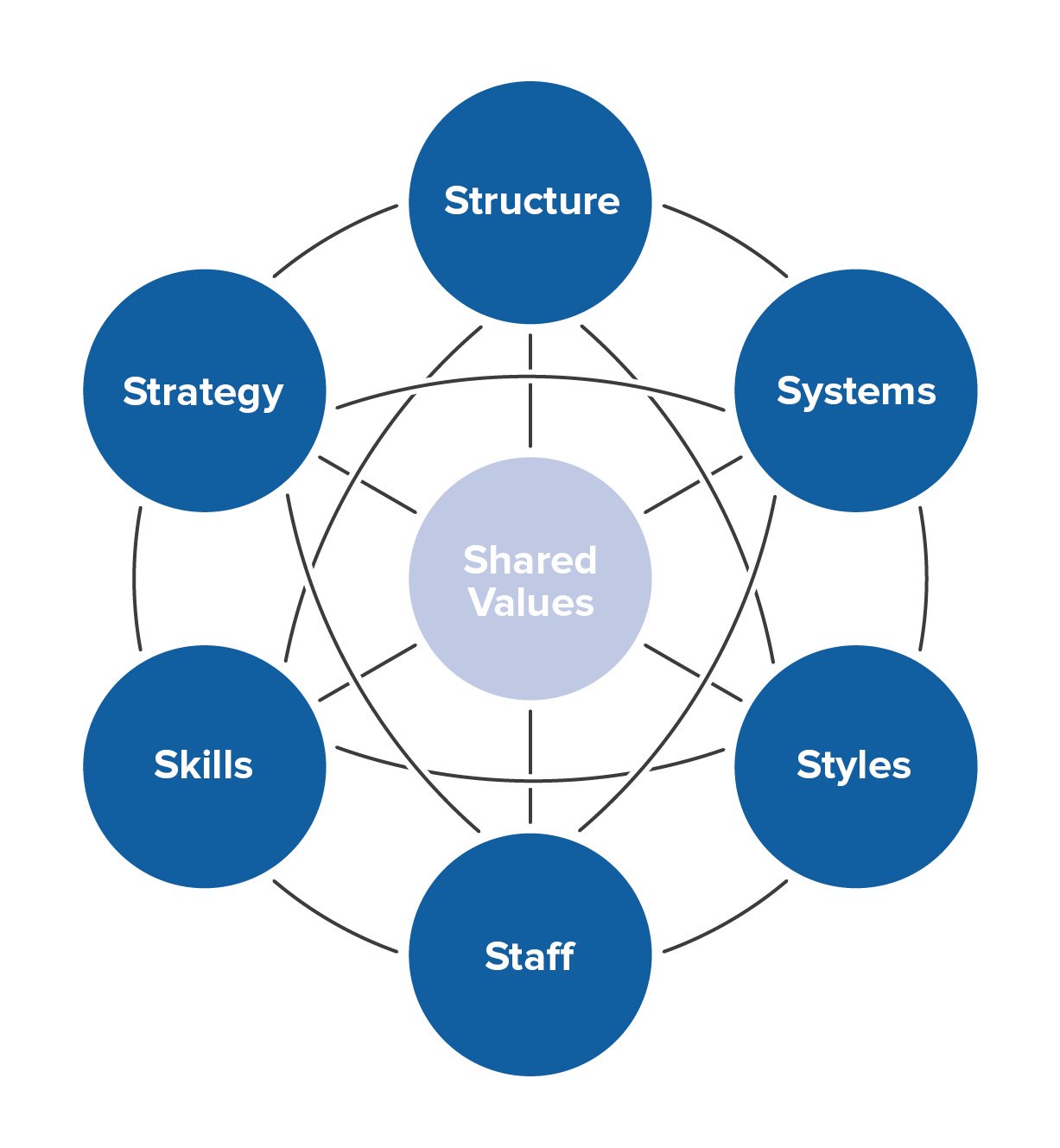
Great LEADERSHIP starts with your VISION using McKinsey7-S-Model to assess a company structure for leaders by Richard Gourlay

Challenges for Leaders Vision

Failing to validate and then alter a business model to reflect changes in the market towards the delivery of a vision. This is the single biggest single reason chief executives fail to succeed. 

Leaders have to carry people with them for their vision to be live. Poor communication skills are at the heart of why visions and therefore leaders fail to succeed. Leaders must be able to create, verbalise and rationalise to others their vision to generate buy-in and carry their senior people with them. Being able to visualise their vision and communicate it to a wide range of stakeholders often stalls or causes failure in strategy delivery.

For a vision to succeed leaders have to build relationships. This starts in developing trust in their future and develop a team culture all working towards that vision. The inability for leaders to invest in developing their vision often results in the lack of trust and development within the senior team.  This failure to develop leadership soft skills, is a major area leaders must invest in to improve their effectiveness as a leader.

Leadership is both Science and Art

Leadership is a balance between science and art. Creating a vision is often seen as an art, but for a vision to connect with senior stakeholders visions require a scientific rationale. It is the old adage we buy with the heart and justify with our head. A solid vision is both a visual message but one backed up with both direct and indirect evidence of that future state in which the leader’s vision sits. A successful vision pulls people together through shred valued values across the organisation what creates and sustains those values.

Great Leadership requires Communication Skills

The importance of being financial and operationally literate to the CEO role is always seen as core leadership skills. These hard skills are often key drivers of leadership assessment. Which is why so many CEO’s come from finance and operations leadership backgrounds. Today these competencies are seen as important for any CEO role.

In todays’ business environment CEO’s are being selected based upon having a demonstrated track record of delivering strategic vision. The ability to inspire others through delivering a strategic vision is now being seen as the most important track record for successful leadership.

Succession Planning 

The importance of succession and smooth transition is becoming more important element for successful leadership. Companies today are investing time and effort in succession planning. Well planned succession planning ensures long-term shareholder value and the ability of avoiding the football management culture of overnight change. Poor leadership choice often leads to cultural conflict and short-term reactionary thinking leads to rapid and unsustainable change. Both these mentalities damage the long-term sustainability of a successful business.  The leadership teams ability to develop successors who are able to support and follow through a vision is becoming an integral part of the CEO role.

Business leaders all recognise that talent management plans, including succession management have become essential for sustained performance in today’s organisations.

If you want to develop your company’s position then there needs to be a clear vision for it. Vitally answering the questions where it is going and why? If your are looking for some advice on developing your company, its marketing, its sustainable competitive advantage then contact us at Cowden.  Let us see how we can assist you, or read more about us in this blog or at Cowden.

Or learn how to plan your business successfully see our video to learn more:-  http://www.richardgourlay.com

Click below to follow us on other social media:-

Website – Linked in – Twitter – Facebook – Blog

Or buy the book on strategy here: Strategy The Leader’s Role 

Strategy The Leader's Role by Richard Gourlay

Cowden is a strategic planning and implementation business which enables customers to grow and develop their business.

Contact Richard Gourlay
Contact Richard Gourlay to discuss your needs.
Name
Email
Customers telephone number
How can I help you with your business or leadership skills?

What Matters In Business For Successful Start-Ups?

What makes a successful company in a market? Is probably the single biggest question a new start-up team must be able to answer. What factors make a successful business has always been a difficult question to answer. So what matters In business for successful start-ups?

The answer has always depended upon who is asking the question!

Unicorn Start-Ups

Dreamers look for unicorns with unique protectable offerings, such as Intellectual Protectable rights, a Unique Selling Proposition (USP).  These dreamers will invest in big step start-ups, market disrupters which will change the markets they wish to operate within. Step changing start-ups such as unicorns (are rare hence the name unicorn), but can reshape markets towards these start-ups. Think about Apple and Amazon and what they have done to the markets they operate within. Today these two are the largest (by value) companies in the world today.  

Unicorns need a unique angle, a technical platform angle, a defendable IP, or a unique (and defendable) operating platform. Even small start-ups can be unicorns if they can identify and control a unique position. Inside Apple’s early technologies was the British made ARM microchip, which propelled it into be a unicorn.  But unicorns are rare, and their window to get established is getting shorter and shorter as competitor awareness and responsiveness is constantly quickening.


Funding Start-Ups 

Traditional funders, such as banks want high returns with low risks, and owners who will take all the risk directly, or being prepared to 100% underwrite the banks so called investment.  Banks do not like, or take risks, which is uncertainty.  Which is why they avoid taking them, unsecured risks are not what banks generally do. So they may support a start-up with a loan based upon a sensible fully costed and robust business plan. 

Banks, who are most start-ups first point of call, often provide a poor place for people to start a conversation with about a business start-up. Start-ups looking for financial support, ideas and how to get a business start-up off the ground often left disappointed by the support which they receive.   

The risk reduction by definition reduces opportunity; in essence if you remove all the risk you also remove all the opportunity a start-up can achieve.  Start-ups often overstate their growth, understate competitor defensive activity and the challenges in getting established. Often start-ups can find better funding through self-funding options, alongside friends and family as stage one seed funding.  It is always best to start small, prove your concept and then go out to market for stage 2 funding with a proven pilot under your belt.  

Start-Up Entrepreneurs Solve Customers Problems

Entrepreneurs genuinely look at solving an emerging problem, the old adage is:-

“The secret of success is to find a need and fill it, to find a hurt and heal it, to find somebody with a problem and offer to help solve it.” – Robert H. Schuller

While the logical approach of bankers is to ride an existing market wave, true entrepreneurs look to create the wave. They are looking at a problem and identifying the ideal innovative solution for that problem’s resolution.


Researching Successful Businesses

So what makes a successful business model includes a whole variety of factors including the core idea, the experienced team, the market opportunity, market access, competition, scalability (the list goes on and on, depending upon who you are talking with) and what resonates with key stakeholders and target audiences.

Recently Bill Gross, CEO of Idealab decided to research this using his extensive range of business start-ups; 100 of his own, and matched by another 100, across a whole range of sectors.  His assessment started by analysing what makes successful businesses. He came across 5 key common factors and he cross-referenced those compared to businesses which have succeeded.

Bill Cross’s 5 keys for a successful business include:-

  1. The Idea: defined and coherent.
  2. The Team:  skills, experience, energy and how well connected.
  3. The Business Model:  comprehensive worked through covering the business need.
  4. The Funding – access to the right amount of money to achieve its core goals.
  5. The Timing – identifying the market timing to meet target audience needs.

The research results contradicted what many thought would be the results across the 200 companies he and his team analysed. This survey included global names such as Airbnb, Youtube and LinkedIn amongst the 200. His analysis showed that of all the factors which can affect success or otherwise of a business, success really came down to these few key ones. They key factors which are common across all markets, sectors and over time  are the defining characteristics for a successful business. But of all the factors one stood out throughout the survey.

Success in Business Start-Ups Relies Upon…

Timing is THE common factor in a successful business at 42%. It is the most common trait of successful company start-ups.

Team came in 2nd, with 32% and the Idea only came 3rd in importance with 28%.  The business model, upon which so many advisors focus their attention was 4th at 24% and the funding came in 5th at 14%.

Timing Is Everything for Start-Ups

The quality fo the idea is not as important as timing. Timing, the driving strategic factor can be identified initially through a thorough PESTEL analysis. Timing is the bottomline performance criteria in driving the success factor for a business.  PESTEL factors set the macro landscape a business operates and defines the timing of its launch. If the landscape is favourable then a business can succeed. I not, then even if everything else looks great then your chances are far lower, than if you get your timing right.

This shift from build and they will come, the old motto of every good idea, qualifies that statement by saying if the time is right then if you build it they will come.

What Matters in Business for Start-Up Success is therefore Timing

If you look at all  successful business over time, then it is always timing that matters. Knowing what to do when really matters for leaders to focus on. The world is full of ideas launched at the wrong time. But get your timing right and the world is your oyster.

From the launch of the internet and the creation of Apple, to the development of low cost airplanes to the launch of low cost holidays, timing is everything. 

The Importance of Research for Start-Up Leadership Teams is Vital

Leadership teams need to focus on answering the question their target customers ask, now. Timing is offering the solution the their customers will pay for today, not waiting for it or putting up with second best. If you can answer their needs when they need it, with what they need, then you are on the first rung to find success. Without good timing you are creating products and services no-one (or not enough people want). Timing is equally important for leadership teams to assess if your product / service can be accessed by the target audience.

Successful companies work with their markets to get their timing right in launching products and services that fit within a market. They can challenge existing customers perceptions but they must be the right product at the right time for the right customer if a business is to succeed.

See Bill Gross, CEO of Idealab Ted talk here:-

https://www.ted.com/talks/bill_gross_the_single_biggest_reason_why_startups_succeed

Like to know how Richard Gourlay can support your business to succeed, then contact Richard here or below.

values in business matter to customers and employees

Values matter in BUSINESS more than ever before as Ikea have just found out

In today’s information driven world, how you do business matters as much as the business you do, as Ikea the iconic Swedish furniture retailer, has just found out. Ikea’s green credentials have been dealt a massive blow in consumer’s minds. Ikea’s failure to support sustainability in its products leaves customers questioning its real values as a business. Heres, why values matter in BUSINESS more than ever before as Ikea have just found out to their cost!  Here’s why you cannot just talk about values, you must live them! 


Ikea only uses 16% sustainable wood! 


Ikea’s failure to achieve its own most modest target of 30% of its wood products to be from certified sustainable wood, will damage it its credibility heavily with its key audiences. The fact that it only hit 16%, has a massive blow on the values it professes as promoting sustainably sourced materials and to its environmental positioning.  Compare that with Homebase (78%) and B&Q (77%), which won the best green award 2010.


The excuse given in its defensive press statement is that it has sacrificed the values of sustainability for rapid growth and protecting its profitability (£2.3billion). But short term greed like this can cost dearly on both growth and profitability over the long term.


Ikea’s staff not telling the truth 


This corporate failure was made worse by staff telling customers in store that its products are from sustainable sources. When in fact they are from illegal logging in places such as Russia. This insatiable drive for growth, which so often undermines trusted names, may damage the Swedish brand’s position as the leader in the flat pack market significantly.  This expose means that Ikea will now undergo microscopic environmental and customer scrutiny.


Greenwash Marketing is NOT acceptable


Ikea’s soft “long term” aspirational statements on their website with links to the Rainforest Alliance are unlikely to be seen as enough in the modern world where green wash marketing such as this are quickly exposed and penalised. When the spotlight of the green world is turned on, it is difficult to hide in the shade.


The World Bank suddenly in the late 1980’s promoted its ‘green credentials’ by promoting itself as having employed ‘an environmentalist’, to offset its image of chopping down forests for cash crops.  This green wash story was quickly exposed when it was pointed out the World Bank employed some 5,000 economists, what difference would/could one environmentalist make?


Values matter in business by Richard Gourlay


Business Values must be transparent


The way you provide your product or service and to whom, says more about you than how much business you do. Being a big turnover company in a highly segmented world is no longer the determinator of success.  How you do your business now determines your current credibility and future success.  Credibility is as much about your values in becoming successful as about the success you have.  The question of size as measured by turnover raises questions about how you do business.


Real Business Values Recognise Real Carbon Footprints


Too often businesses have slick marketing messages, from slogans and statements, rather than understanding what impact they are making on the world in everything they do, their carbon footprint. As Carbon footprint becomes clearer so businesses must adapt to reducing it throughout their entire impact upon the planet and reflecting that in the values they actually demonstrate.


Your values as an organisation as demonstrated by everyone inside your organisation matter to both existing and potential customers in choosing to do business with you. People have choices and they can now exercise them more freely than ever before, and that means customers can access information instantly to make choices that are more informed. Ikea’s staff misinforming undercover Times reporters about their sustainable and certified sourced products at a number of shops are one symptom of Ikea’s rapid growth boardroom culture.


Vision Mission and Values in business Strategic Planning Workshop by Richard Gourlay


Values Must Live In The Moment 


Almost everything in life is in real time and instantly communicated to circles of influence and beyond. A restaurant having  bad night can have a poor reputation before the starter has even been cleared away as customers post live feed back to sites such as Qype or Trip Advisor . Therefore, before the waiter, maitre d’ or chef knows what’s happening the world outside already does by Twitter and Facebook and are cancelling their reservations in their droves.


Why clean lavatories matter?


The old adage that if you want to know how clean the restaurant kitchen is, inspect the lavatories. This is because they tell you how the restaurant values cleanliness, is a great example of modern customer awareness. Do you live your values or just post them on your website? Is the question customers want to know in establishing and experiencing trust with you and your brand.


You can spend as much as you like on your website, Google reviews and trip Advisor comments, but simple first impressions such as the state of lavatories matter more to customers.


Rail companies are learning fast


The recent story of the man on the train talking too loudly causing enraged customers to Tweet  complaints about his behaviour which was picked up by a duty manager hundreds of miles away who then contacted staff on the train to track down the loud caller and asked him to quieten down.


This story is very much testimony to the growing demands of customer expectations, immediate online response, not waiting for passing train staff to react. This story is part of the reputation shift that train companies are actively pursuing.


Values are in the detail


Values matter, they define the real differences between companies. How British Airways treats its customers through the values it embeds in its entire organisation is what makes it different to other premium airlines and distinguishes it from them, and from the bucket providers such as Ryanair.


However, as everyone de-layers in response to changing business models, cost and modernisation requirements, values can be lost in the rush to modernise and compete in new ways. BA’s changes to its premium dinner menu, introducing exotic main courses such as crocodile and ostrich sounded good but simultaneously cutting the After Eights, so there was not to go around 1st class passengers was a classic example of getting its values wrong in its customer’s eyes.


Values Must Involve Everyone in the organisation


If you value your customers then remember everyone needs to smile in their role, if you believe in providing excellent customer service then don’t cut your front of house staff numbers.


Too many companies’ ideas of communicating values are to place a statement on a website, brochure, at reception and on the induction training programme. How many companies look at the strategic advantage of values and embed it into people’s roles, asking staff to define their role by those values by redefining their role to live those values?  How many companies review those values as outcomes in winning and retaining customers?


Business Values as seen by Employees and Customers


Customers, potential and existing, are drowning in choice.  What makes you stand out to them is the values you own and can demonstrate as a business. Statements on walls and websites always sound good, (possibly, because they are written by marketing people who do not work there) but unless the company lives them, then they do more damage than good. Over promising and under delivering is a growing experience for everyone today.


Whether it is a London hotel, stating it’s exclusiveness, as evidenced by its 5 star, pretty pictures on the website of its presidential suite and over the top statements such as “sumptuous 5 star accommodation” the jaw dropping price tag. When you turn up and find a broom cupboard with not enough space to turn around in let alone swing a cat, and you are one of 500+ rooms filled with bus loads of tourist on a package holiday then company values are under pressure.


The same is equally true for staff. Why should people stay loyal to you if you don’t live those values and enshrine them in every one of your people. Do they live it or lip service it?


New company’s leadership must create and live their true values 


New companies have the unbridled opportunity to define their values from the start. By building them into their business model throughout the entire process from the beginning, providing value and clarity with every new role and new person, they can use their values to maximum leverage for attracting their chosen customers and staff.


So Googles’ “DO NO HARM” value won many plaudits, breaking down the concern about the is was then rightly questioned by their policy in China of being seen to be supporting censorship (try typing Tienanmen Square Massacre into Google in China it never happened!).  Now there is a good argument that rightly says any Google is better than no Google, but the contradiction against their stated values upset many Google Supporters elsewhere in the world.


Your values should come from within. What do you stand for? What does your company do? How should everyone do it? What does excellence look like? Some classic questions to understand the values you offer. I often ask people to think of an animal or car which best describes there organisation


Keeping Values Alive       


Established companies inherit values, often without realising they have them in place, “its how we do it around here” type phrases are often values hidden inside everyday activity. Keeping values alive is often hard in rapidly changing under-pressure environments. Changes in leadership, particularly when cross industry leadership is introduced or when new pressures are introduced from changing ownership for example often end up throwing out the hidden value of a brand in the race to achieve short-term results.


Everyone entering a company, particularly top executives, must understand the core heritage values any organisation has, how they are owned and expressed. The best way to achieve that is for new people to present those values back under peer group review and add to them with the changes they intend to introduce. New products / services need to incorporate core values and learn to demonstrate them in new ways as new channels of communication are opened up. Here is a simple checklist for business leaders to use to answer honestly and thoroughly about where you are with your business values.


Values Check List 


  1. Are your values visual to your team and customers? 
  2. Does everyone know your core values, have you checked?
  3. Can all your people translate them into their daily role?
  4. Do people see the company values in other people’s roles within the organisation?
  5. Do customers comment on those values in their dealings with your company in formal and informal feedback channels? 


If you can only answer confidently to points one and two then you are not living your values as a business. If you cannot hand on heart even answer those two, them it’s probably time to look at your values in a lot more detail.  Spend time to think through what you and your business stands for and get in touch if you need any assistance in creating values which matter to you.


Leadership Strategy


Learn more about strategy and leadership and how as a leader to create your strategy, with all the steps to build your own strategy, click here to buy the book now:-


Values matter in business more than ever before, red more in Strategy The Leader's Role by Richard Gourlay is a book about business strategy for leaders to grow and develop their strategic plan for their business.
Learn more about business values and cultural impact in Strategy: The Leader’s Role by Richard Gourlay .