Mentoring using teh GROW model to mentor directors

A good business starts with the EXIT in mind, THINK EXIT

Here’s a simple question to any business owner, why are you in business? The flippant answer I often hear is to make money.  An honest, if not inspiring answer.  But there is a fundamental flaw in that statement which many business owners fails to comprehend. They start a business, typically through experience in, or a passion for the field or because they have seen an opportunity to make money, but fail to achieve that ultimate goal because they fail to plan their end, their exit strategy. Thinking through your exit plan from your business should start when you plan your business on day 1, not wait until the end if you want to leave on your terms. Learn more about a good business starts with the exit in mind, THINK EXIT

Are you YOUR business?

If you can’t get out making the money you intended to when you sell up then why did you set up the business in the first place?  You have a great idea, you work on it, and spend your energy (and life) building your business until it becomes you.  It succeeds and you enjoy the lifestyle it brings.  Then the real challenge of maximising that income to free yourself up and retire or do something else begins.

That final stage often becomes impossible because you are the business and it is you, its lifeblood, main cheerleader and driving engine. To any potential buyer, they see that you are the business, its key asset and real value. This is why buy-out clauses often tie-in existing business owners so that the value that the former owner delivers can be transferred to the new owner. This is a typical scenario of being a successful business owner.

Business owners are driven by the passion to run the business day-to-day. This often overshadows the failure to plan the owner’s exit strategy from the start. To achieve that, owners must build a business with the clear objective to enable the owner to get out and maximising the sale value from what they have achieved. Nearly all business owners focus on building a successful business, but not on making sure they maximise their returns from the successful ownership of the business they exit.

Exit Strategy Planning

The real payback from all that hard work in creating and setting up a business for an entrepreneur is the final payback. It is in the shareholder value being realised by a sale of that business. Few owners think about realising their shareholder value, being more interested in the Profit & Loss than the Balance Sheet when making key decisions about the business.

That approach is effectively summarised in the phrase; the turnover is vanity, profit is sanity and cash is king. This great motto in the running of any business. But it does not hold true in achieving exit strategy success as a business owner.

Exit Strategy: think like a Shareholder

Achieving shareholder success is the only motto to follow if you want to have a saleable asset.  Owners need to focus on developing an exit strategy which achieves their personal goals.  While profit and cash rule the day, building a valuable asset requires building shareholder value, through building sustainable long-term profitability.

Success in business requires owners to build a business which you own but are not concreted into the business foundations. Building a forward strategy for your business is a vital first step in building your exit strategy.  It is the old adage that you need to work on your business not in your business for success. This great motto underpins successful entrepreneurs.

THINK EXIT is Long-Term Thinking

Short-term profitability is always an important goal. But long-term share value is a strategic consideration which owners need to consider in building the value of their business. SO a good business starts with the end in mind, THINK EXIT.

If you would like to discuss this article further or further information about our services in working with business owners in achieving  successful exit strategies then contact us at enquiries@cowdenconsulting.com or see our contact page for further options.

Like to learn more about creating and leading a business, with a successful exit strategy in place? Then click here to buy the book with all the tools you need to become a better leader: Strategy The Leader’s Role by Richard Gourlay

Read more “A good business starts with the EXIT in mind, THINK EXIT”

Leadership Development by Richard Gourlay

Business Success: Starts with the END in mind

Here’s a simple question to ask any business owner, why are you in business? The answer to such a simple question can be very enlightening. The flippant answer is to make money: an honest, if not inspiring answer; but there is a fundamental flaw in that statement which many business owners fails to comprehend. They start a business, typically through experience in, or a passion in the field or because they have seen an opportunity to make money, but fail to achieve that ultimate goal because they fail to plan their exit strategy.  Planning your exit strategy on day one of setting up upper business is the hidden key to business success. So remember that business success: starts with the END in mind.

Start with the END in Mind: Strategy

Most business owners focus solely on profitability as their key measure of success. Yet making a profit from a business is more than just yearly profitability. It is also about building a business which is an asset that your target buyer is looking to buy. If you can’t get out making the money you intended to when you sell up, then why did you set up the business in the first place?

You have a great idea, you work on it, and spend your energy (and life) building it until it becomes you.  It succeeds, and you enjoy the lifestyle it brings then the challenge of maximising that income to free yourself up and retire or do something else with your success.  That final stage often becomes impossible because you are the business and it is you, its lifeblood, main cheerleader and driving engine.

This typical scenario of being a business owner, is driven by the passion to run the business day-to-day overshadowing the failure to plan your exit strategy from the start. That is building a business with a clear objective to enable the owner to get out and maximising their income from what they have achieved. Nearly all business owners focus on building a successful business, but not on making sure they maximise their returns from the successful ownership of the business.

Business success starts with the END in mind by Richard Gourlay strategy planner for business owners

The END in mind

The real payback from all that hard work in creating and setting up a business for an entrepreneur is the final payback, the exit payoff.   It is the value creation in within the business, the shareholder value being realised by a sale of that business, which makes al the hard work worth it.  Few owners think about realising their shareholder value. Most being more interested in the Profit and Loss than the Balance Sheet when making key decisions about the business. That approach is effectively summarised in the phrase;

Turnover is vanity,

Profit is sanity but

Cash is king,

This great motto in the running of any business successfully. Cash flow is the lifeblood of business success. But, this does not hold true in achieving a successful exit strategy. Success as a business owner is not measured by turnover, profit margins or the mountain of cash your business generates, but what the business delivers back to those who own it. So I would add to that classic phrase;

true business success is the shareholder value it generates.

Achieving shareholder success is the key motto to follow if you want to have a saleable asset. Shareholder value reflects the true value of your business when you decide to sell up and move on.

Business Success

Business owners need to focus on developing an exit strategy from day one which will enable them to achieve their personal goals.  While profit and cash rule the day, building a valuable asset requires building shareholder value, through building sustainable long-term profitability. Building the business assets, the real shareholder value, needs to include strategies around Intellectual Property (IP), long term profitable contracts, strategic relationships and operational excellence that maximise the company’s value to targeted purchasers.

Successful Business Planning: Starts with the End in mind

Success in business requires owners to build a business which you own, but one you are not concreted into the foundations of its success. Building a forward strategy for your business is a vital first step in building your exit strategy, it is the old adage that you need to work on it not in it which underpins all successful entrepreneurs.  

Building the forward strategy to exit, is therefore different that just building a successful business. Planning from start to exit, means focusing on the exit strategy requirement of increasing shareholder value which is recognised as valuable assets by target buyer audiences.

Short-term profitability is always an important goal, but long-term share value is a strategic consideration which owners need to consider in building the value of their business. If you would like to discuss this article further or further information about our services in working with business owners in achieving  successful exit strategies then contact us at enquiries@cowdenconsulting.com or see our contact page for further options.

Vision to make change n business by Richard Gourlay

A good business has clear objectives and goals to achieve.

For leadership teams planning a business is focused around the annual exercise of business planning.  Reviewing what went well and what did not, reviewing the overall performance of the organisation, its profits (or losses) and deciding what to do differently and what to keep the same for the forthcoming year. That’s why a good business has clear objectives and goals to achieve.
One key area which good leadership teams consistently get right is in rolling out the right measures, both soft and hard measures of performance inside a business plan. Cascading business plan objectives down to department and down to personal performance objectives are the vital element in implementing a business plan successfully. The key ones include refreshing the vision and connecting clear objectives and soft and hard metrics together to all levels of the organisation.

Business Goals

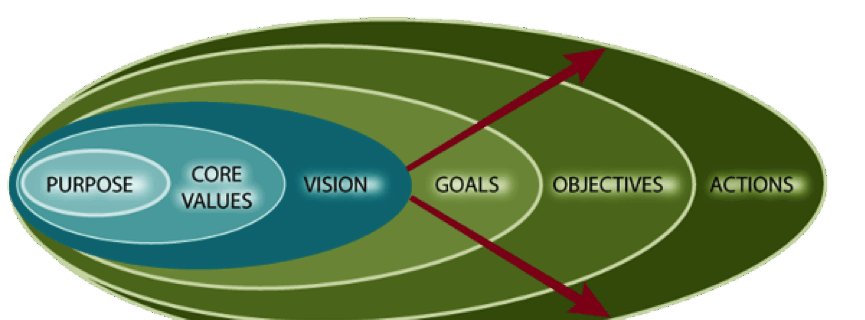
Having a vision is vital to be successful in the long term, but having objectives will ensure you get you there. Clear milestones for everyone inside your company, top to bottom are the essential component of a successful company. Every successful company has clear goals, strategic ones the outrageous ones (global domination) through to achievable tactical objectives.

Without clear (SMART, see below) objectives a company will loose focus on its goals. Poor or non-specific objectives companies can fall victim to strategic drift, this month’s whim and next month’s quick idea.  The failure to cascaded objectives at every level allows good people’s morale and confidence to fall. This is because they cannot see where how they are contributing to the company’s success. Everyone should know how they contribute to the business plan’s success. Failing to set clear objectives in a business plan creates a path to failure in execution and devalues the process of business planning and it becomes a waste of paper, time and effort.

Business Objectives

Objectives should be like a pyramid, with the big objectives at the top, but at every layer underneath there should be the sub objectives that make the bigger one happen. A well run organisation should therefore look like a pyramid, in terms of objectives, with everyone working on their goals which build up together to achieve the big picture goals. This form of management managing by objectives MBO, (not to be confused with a management buy-out MBO), allows people to focus on their objectives, which are aligned to higher goals.
Try not to have too many objectives to achieve. I always recommend no more than 5 per person. The reason why 5? Because it keeps people focused and not drowned in statistics. Even at the company level remember the old KISS concept of simplicity, if you have page after page of objectives some will suffer unless you can resource them. Focus on what really matters to the business, what drives performance and how are they made up. For people think about their Key Performance Indicators, KPI’s they are doing a good job if… Classical KPI’s usually include: revenue, margin, customer numbers, retention, growth, production, saving, are amongst the most common.

Setting Business Objectives

High performance companies often drive all their goals by setting team objectives which are then broken down into Key Performance Indicators (KPIs) for each individual employee. Try not to give any individual or manager too many. An easy way to achieve that is to ensure they can remember and recall them with ease when you meet them.

The benefits of setting good objectives:

1.       Objectives define the entire purpose of your business (or unit) in a couple of sentences or bullet points or set of numbers.
2.       Objectives are often identified as key performance indicators at the individual persons performance.
3.       The objectives that you set determine the quality of the strategy or tactics that you will adopt.
4.       Goals allow leaders to Manage By Objectives MBO. This avoids time in argument and also helps in introducing a more participative management culture where employees are encouraged to set their own objectives.
5.       Clear KPI’s per person is a successful way to evaluate performance as long as the KPI’s are numerate or translatable into a numerate language.
Remember SMART criteria to define attributes of good objectives:
That is:
·         Specific
·         Measurable
·         Achievable
·         Realistic
·         Timely

Achievable Goals

If goals and objectives are not SMART then they are unlikely to be achievable.  Being better or good for example is too often quoted as a goal or objective, and while that is a statement of direction it is not a clear viable goal or objective. SMART goals and objectives are tangible they are a defined quantifiable number or a supported qualitative measure compared to an existing one.
Goals must be achievable. But for that to happen they must be quantifiable, either numerate or benchmarked compared to a previous number and deliverable within the timeframe to the standard required.

SMART criteria include:
1.       Both short range and long range targets should be set.
2.       Both quantitative and qualitative
3.       Clear. Put them in writing, to be achieved within a specified time frame.
4.       Measurable. So that they can be compared with actual results.
5.       Challenging. This is so that staff will put greater effort and be more motivated.
6.       Achievable. Avoid overly optimistic goals as this might be counter productive due to their demotivating nature.
Goals should be realistic, reasonable, reachable and beatable. Avoid hidden goals and don’t be over specific.
Hope that gets you thinking? Want to learn more then contact us or click here