Creating A High-Performance Team Culture

In the contemporary business environment, cultivating a culture of excellence is often regarded as the pinnacle of effective leadership. Such a culture serves as a strategic asset, providing a distinct competitive edge that facilitates sustained growth, enhances employee engagement, and improves profitability. Creating a high-performance team is therefore a strategic decision a leader takes to create and sustain competitive advantage.

A high-performance work culture extends beyond leadership alone; it embodies an organizational ethos where every individual is dedicated to achieving outstanding results. This necessitates an environment where employees feel empowered to challenge existing practices, seek continuous improvement, and foster innovation—hallmarks of an environment rooted in excellence.

The Purpose of Excellence

For any leader, establishing a high-performance culture is not an instantaneous act but a deliberate strategic endeavor. It involves creating, nurturing, and maintaining an organizational climate conducive to excellence. The underlying motivation— the “why”— centers on the tangible benefits such a culture imparts within its sector. Achieving this requires significant investment in terms of time, commitment, and energy; however, the resultant advantages justify these efforts.

The rewards of fostering a high-performance culture include enhanced innovation leading to increased profitability, improved market positioning, stronger customer acquisition and retention, and superior talent retention. As articulated by Dan Pink in his seminal work Drive, motivation rooted in mastery, autonomy, and purpose depends fundamentally on a robust supporting culture. Without such foundational elements, these motivational drivers cannot realize their full potential.

In essence, cultivating a high-performance work culture is an essential strategic priority that yields long-term organizational resilience and success.

Leading by Example

At the forefront of any environment of excellence is the leadership’s vision. A vision explains why we are creating a high-performance culture. That starts and ends with the leadership’s actions in everyday behaviours. Are they walking the walk or just talking the talk?  Leaders must create the right environment for a culture to exist. Leaders must focus on developing the “How do we do this better” questioning while creating a safe space for people to try, and that starts by asking awkward, uncomfortable and challenging questions.  

To get better we must break what we have always done.  Not accepting the ‘good enough mentality’ or ‘it’s not costing us anything to keep it as it is’. The other major danger leaders’ face is letting a committee acceptance approach to retain the status quo. Ask the importance question ;does everything we do add value to the customer?” or “Can we find new ways to add value to our customers?” Is a better question! As is; “What do you think we should do differently to be more valuable to our customers?” This mentality creates an engaged workforce that challenges them to not only try but feel safe in looking for new ideas. 

Leadership’s Role in Cultivating a High-Performance Culture

Central to fostering an environment of excellence is the clarity and consistency of leadership’s vision. A compelling vision articulates the purpose behind establishing a high-performance culture, serving as a guiding light for organizational efforts. The realization of this vision hinges upon leaders’ daily actions and behaviours—whether they exemplify the standards they set or merely articulate ideals without tangible follow-through.

Effective leaders are tasked with creating an environment conducive to continuous improvement and innovation. This involves cultivating a mindset focused on “How do we do this better?”—a question that encourages reflection, learning, and adaptation. Equally important is establishing a safe space where individuals feel empowered to experiment, challenge existing practices, and voice difficult or uncomfortable questions without fear of reprisal.

To progress beyond current limitations, organizations must be willing to challenge ingrained habits and assumptions. This requires moving away from complacency rooted in the belief that maintaining the status quo incurs no cost or consequence. Instead, leaders should consistently ask whether their actions genuinely add value to customers. An even more impactful inquiry is: “What should we do differently to enhance our value proposition?” Such questions foster an engaged workforce motivated not only to try new approaches but also to feel secure in taking risks that lead to meaningful improvements.

Creating a Culture of Excellence

Starts with a clear statement of intent, what are the standards you expect to see throughout the organisation. Define what excellence means within your organisation. By establishing expectations and defining them in language to each person within their role. That requires that every touch point, from recruitment, people engagement and development through to KPI and day-to-day operational and behavioural activity. 

Leaders must display that excellence. By leading from the front, especially in the small day-to-day people engagement behaviours in listening, learning and problem-solving. Setting the standards can only come from leaders and their behaviours. 

To create a high-performance culture to exist people must be continually learning to create continuous improvement.  A learning culture in both formal, professional development and informal learning especially with mentoring and peer support is an essential pilar of the environment of excellence. In Dan Pink’s book Drive several examples of learning reflect this in different environments in delivering what he terms autonomy, from Google’s 20% employees time self-invested in personal projects through to recognition of learning in what he terms mastery of a topic area.  

The key element leaders need to focus on are in creating a positive challenging environment. One where people feel safe to challenge themselves, challenge the status quo and challenge why not perception.  That challenge leads firstly ‘a growth mindset’ asking where can we take the organisation in both capability and capacity? Intellectually that is supported by a clear vision of where we want to be that supports and sustains that challenging drive to be better. 

High-Performance Culture

Trust Matters

A growth mindset is built upon doing the right things consistently. From believing in others intentions, to let them look beyond what we currently do, through to creating an emotional safety within their organisation that fosters integrity and responsibility. 

Leaders must enable a safe fail learn faster trusting mentality, that rewards people who try and learn rather than those who play it safe or look to shame those who fail. Giving accountability over to people to try something new and developing feedback to enable fast learning rather than running away from early failures. 

That emotional safety is a cornerstone of a high-performance culture. As Steve Jobs famously said, “There is no point hiring the brightest people and then telling them what to do?

Feedback Drives Culture Change

Feedback is an essential element of a growth mindset. Ultimately feedback is the only outcome that matters in a high-performance culture. Excellence-driven organisations create multiple open feedback loops. Feedback loops are the result of true honesty within an organisation culture and drive the ability for growth to happen both rapidly and constructively. 

Honesty in feedback is not a negative, but an essential element in challenging assumptions. Where can it be better is what feedback should be focused towards. So positive feedback loops including arenas such as brainstorming, project design, pilot testing as well as process engineering.  

Supporting High-Performance Teams

An environment of excellence is underpinned by a continued support for others. From being available to walk the walk around the whole team, through to resource provision and mentoring through to the essential leadership role of being a resource provider. 

Supporting cultures are enablers and sustainers of an environment of excellence which underpins high performance. A culture of supporting is linked to the overall vision and capability creation enabling individuals and teams to perform to new higher standards. Support in resources is not just financial, although that is important but also in ideas, emotional engagement, in having time to listen and understand as well as connect people to the right resources.  

Resisting Resistance 

A supporting culture is also essential to deal with managing employee and stakeholder pushback. Dealing with change is the single biggest challenge to creating an environment of excellence to deliver a high-performance culture. Resistance comes in many formats form active hostile resisting actions through to passive resistance in non-compliance.

A supporting culture is the most effective way to overcome the lack of active engagement. For an environment of excellence to emerge leaders must acknowledge resistance from those who feel threatened. Listening to their concerns, perceptions and reading between the lines as to why they might or are resisting and offering solutions without compromising your goals as a leader are vital to create the environment that delivers high performance culture.

Defining expectations, often turning aspirational language into practical steps and outcomes often reduces and mitigates fears and uncertainty in change. Clear expectations matched by tangible behaviours which can be trained and adopted overcome misunderstood aspirations.

Supporting others must also deal with underperformance. Ensuring that performance matters and is impact is fully realised and clarify that they must achieve the new standards with support and timeline that improvement. 

While many leaders overfocus on those underperforming an environment of excellence requires leaders to shift their mindset away from underperformers to those who excel at making change. 

“Don’t reward failure with your time, reward good behaviours with your time and resources”.

Investing your time and praise for those going in the right direction is the right messaging inside any organisation. While initially seen as counterproductive to good management, deal with under performers it works to spend time working with those who get it to pull and nudge those who should get it to make the move. This not only drive the environment towards excellence. Not only that but is far more rewarding and less energy draining.  

Leading by Stepping Back

To deliver a high-performance culture we need an environment of excellence, but that is not singularly down to the leadership team. Creating champions across and throughout the organisation creates a team effort in delivering results. Engage employees to construct it, find champions from early adopters, create champions of change for each stage of your development of the environment, so that you have a team effort and cohorts of people who are part of the solution which they can shape and drive. 

Leading from the back can only happen when champions are in place, and leaders can step back and see what is happening and where they need to concentrate their efforts and resources. If a leader only leads form the from then they often miss what is going on behind them. 

Stepping Back to Sustain Excellence  

Stepping back also allows leaders to ensure proper oversight and monitor performance throughout the organisation. Knowing where to pace change to find quick wins, and customer requirements and respond to pressures and opportunities requires leaders to be able to see and feel what is going on. Being a resource provider, a leader is there to be available to overcome barriers and develop team and cultural resilience.  

High Performance Culture

There are so many benefits to create a high-performance culture in today’s business world. Pushing people to do their best, and be the best they can be, delivering creative and innovative solutions that is recognised and rewarded. 

Building the environment of excellence within which a high-performance culture can grow, and flourish starts with a clear vision, supporting a growth mindset of trust and a supporting environment within which a culture can thrive. 

The end goal is creating an environment where everyone pursues being excellent in everything they do.

Like to know how we can support you create a high performance culture, then get in touch below.

Growth planning in business

Turnaround Your Business: The Garden Rooms Case Study

Case Study a Garden Rooms business in Scotland

Turnaround Your Business with Richard Gourlay

A Garden Room

Turnaround Your Business

The owner of a Garden Rooms business in Scotland approached me to turnaround his business. Operating in a potentially growing market designing home garden rooms, such as offices, bedrooms and gyms while also still building home extensions. He was struggling to run these businesses, spending most time running around firefighting and dealing with unhappy customers. To turnaround your business often external advice and active support is essential, here’s why.

The Situation

The owner was trying to run too much at the same time, which put him under: –

  • Financial pressures: no real financial model and limited systems in place. With little cost management or operating and margins in place, putting continual pressure of the business’s finances and margin impacts. 
  • Operational issues: with no operating systems in place each project ran differently, which lead to a wide range of quality and complaint issues, including legal disputes.
  • Quality issues: with staff firefighting onsite with suppliers to get components to site on time, impacting upon delivery times, production and cost and quality impacts.
  • People issues: of unhappy and unmotivated staff, no one really knowing what they were being asked to do and good staff leaving. 
  • Ultimately there was little customer focus and significant firefighting, unfinished jobs with a long list of snagging issues to be resolved.

Our Solution

Working with the key people we developed a clear business strategy and culture shift for the business, identifying the businesses core value proposition and a customer focused ethos.

This led to a complete process of change and focused team actions to re-invent the business around its core value proposition and improvement plans to redesign out all root cause issues within the business. 

Following this process we then developed a customer process map.  This identified every customer value added step and supported the customer through the entire process. With a new marketing strategy also in place we were able to improve: –

  • Customer engagement and acquisition which led to an improved Average Order Value (AOV) of 55% in one year.
  • Ownership of issues by frontline staff to get it right for the customer, reducing snagging and issues to a controlled minimum, with everyone pulling together.
  • The development of product improvement and a full product range to support customer retention and conversion, making the business the dominant player within the target market.

This Enabled

We worked with the owner developing his business and his skills to lead his business more successfully, providing support and guidance throughout. This was supported by clear business planning with the owner with a full strategic and operational business plan in place. 

  • Clear success goals shared with the team. 
  • A forward annual business plan covering every aspect of the business. 
  • Sales goal setting which supported and underpinned the financial plan.
  • A comprehensive financial and cashflow model to ensure the business is cash positive and profitable for the first time.
  • The owner was able to positively look at a trade exit strategy from this business. 

Turnaround Your Business

Revitalising, recreating or jest evolving your business is an essential requirement to become and keep being competitive within your market. Don’t wait until it is too late. The earlier a business leader identifies they could benefit from a strategic refresh the more options and quicker positive change can happen. To turnaround your business with Richard Gourlay then lets have a chat with Richard here now.

Great brand by Richard Gourlay leadership and strategy

What makes a great BRAND

What makes a great BRAND?

Despite what marketing people passionately believe most people don’t think about brands, they just get on with their lives. The coffee they buy, the supermarket they go to and petrol station they visit happen almost by accident. In Britain today we are too busy to think through these everyday inconsequential purchases, focused on saving time, not forgetting something or rushing from place to place on a tight deadline. So do brands matter as much as they used to and if so why and how?  Brands matter where consumers can value them.  In today’s wealthy world every product or service perceives itself as a brand, even if it is just a label. So what makes a great brand?

Consumer Choice 

Let’s start with the basics, the consumer has choices. Endless choices if they choose to use them. But in many everyday cases as in my examples above, the consumer sacrifices those choices for simple expedience. The inability to see (or value) brand differentiation, between Starbucks and Costa, between Tesco and Morrisons between BP and Shell, and yet they each fight for space in consumers minds through tiny differences which if we stop and think about do actually exist and we the consumer do actively value.

So much more than First Impressions 

So in today’s Britain, what is important about a brand? Is it the halo effect, the first impression, like the smile on the front of a car or is it something more, something deeper and more tangible? Ask the owners of Sunny D (the 90’s orange juice lookalike) and you will find that the halo effect does not last if your brand is not true to itself and to its consumers. Customers have to believe in a brand, it must tell the truth, be transparent and honest if it is to be successful. Gerald Ratner (former MD of Ratners the jewellers who said about his products “because it’s total crap”) also found out that in today’s world everyone must truly believe in the brand, not just the marketing department but the whole company has to believe it and most importantly practice the brands beliefs.

Clear Brand Strategy 

Being clear and precise is also important in the company’s messages for a brand to succeed, a strong undiluted brand message must enthuse internally but must also consistently connect with customers through touch points, look at Innocent, Dorset Cereals or Apple as classic examples of touch point. They also demonstrate a clear story delivered with passion about who they are what they do and why they matter. This focused and consistent message is not just a marketing message but an ingrained set of values which consumers buy into with passion. These brands not only position themselves as premium players in their fields and earn more but they also continuously find new ways to spread their key messages to customers, they have a clear brand strategy to achieve it.

Everyone Lives the Brand

Another vital aspect of any brand success is that the people within that brand demonstrate what they preach, they live that lifestyle, support that brand and contribute to its success. It is their lifestyle, it is a part of the way they and their brand do business.

Great brands go beyond the brand to understand its real value to existing customers but also to tomorrow’s customers.  Whether it is a family run local shop or a global supermarket chain great brands position themselves so they develop and hold a market position to develop long-term success.

Vision and Purpose

Great brands create, sustain and evangelise a culture which supports and drives their brand. Creating a culture which underpins an organisations vision and purpose is a key prerequisite for ensuring sustainability of a great brand. Sustainability of a vision can only be achieved if the organisation is supported by an underlying culture which fits with the brands ethos.

Great brands can only transpose from the innovative visionary founder if they create a supportive culture to sustain the brand. An effective and appropriate culture is one which supports the brand and ensures it is can sustain its market position over time.  Great brands sustain themselves through a great culture.

The culture of a brand, otherwise seen as the handwriting of the organisation, enables sustainability of the brand over time. Culture today matters from how people work together through to acquisition of appropriate talent. The right people are drawn to a brand they aspire to be part. Business partners focus on brands with likeminded cultures andante to be part of a great brand. In the exact same way customers aspire to be associated with a great brand.

Great Brands are not Labels

Great brands drive markets. By challenging them through innovation and changing perceptions. Labels on the other hand feed off brands by picking of successful innovations for downstream ‘me too’ market following customers. Great brands invest high proportions of their resources in driving markets forward, through innovative products and services. Great brands are seen to out invest other players more double the the market average.

Creating innovative pipeline cultures thinking long-term make positions rather than short-term tactical single product successes. Labels focus on creating  market winning season products, they act as followers often being low-cost alternatives to the brand leaders in any sector.  Brands focus on the longterm innovation which shift the paradigm of relationship with the customer through the brand.

Great Brands Add Value

Great brands also develop their own uniqueness, not just the product or service but the whole package is how we do it around here. There needs to be not only consistency but the brand hand writing and value on how they do it. The best brands always develop singular simple signals for customers, cutting through jargon to create clarity without patronisation.

For brands to succeed in today’s global markets these golden rules have never been more important as consumers have never had so much information, but if you follow these simple rules of brand success you can develop and maintain a great brand.

Looking for Advice  

If you want to develop your company’s brand and are looking for some advice on developing your company, its marketing, its sustainable competitive advantage then contact us at Cowden  to see how we can assist you, or read more about us in this blog or at Cowden

Click below to follow Richard Gourlay on other social media:-

Website – Linked in – Twitter – Facebook – Blog

Cowden Consulting is a strategic planning and implementation business which works in partnership with customers to grow and develop their business, contact us to learn more.

Posted 1st December 2011 by Richard Gourlay

Location: Old Glenstocken, Colvend, Stewarty of Kirkcudbright, Galloway

Labels: brand brand identity brand strategy brand strength branding business success marketing strategy strategic direction strategy sustainable companies values vision

Leadership Development by Richard Gourlay

Great LEADERSHIP starts with your VISION

Great LEADERSHIP starts with your VISION 

Having a Vision for your business is the most important leadership trait for a successful leader to have. For leaders to lead they must have a strategic vision for their business. A clear future state they want to achieve. One which provides not only an optimum place within their market they want to be; but one which inspires, motivates and drives the organisation to achieve. Heres is why Great leadership starts with your vision.

Great leaders may be charismatic, they may even be likeable, but for them to be successful they must be able to communicate and inspire others through their vision. A vision is a future place within tomorrow’s market.

Leadership Vision

Leader’s must create a vision which is not only aspirational for themselves but motivational for the all stakeholders.

A recent survey of 1,439 chief executives and senior HR people from 707 organizations across the globe, found that the outstanding trait of successful leadership is the ability to create and communicate a VISION.

This is the single most important characteristic for success.  Amongst those interviewed a clear vision scored an impressive 92% amongst such high level people in business. This demonstrates just how important a characteristic this is in creating a successful leader.

Vision to make change in business by Richard Gourlay in this article: Great LEADERSHIP starts with your VISION


“Without a clear vision no leader can succeed today in business”

Creating a VISION

Creating a vision is not easy. Leaders are busy people fighting to keep their business on track, dealing with day-to-day issues and making decisions based upon facts and figures. That last point is therefore a real challenge for leaders in developing a vision. This is because there are no facts and figures about the future. The future, by definition is unknown. Instead leaders must rely upon a range of forecasting tools, from gut feel or by benchmarking agianst others, to develop their vision of what the future might look like.

Each of these options in forecasting the future are fraught with danger and risk. Both in terms of making decisions based upon inaccurate perceptions or the damage to their credibility as a leader. Following others through benchmarking is always the safest option for leaders. But this limits leaders to be a follower within any market sector, rather than to lead it from the front in their sector.

Great Leadership deals with Change

For leaders to lead, they must be able to deal with change. Change happens in-perceivably until it is obvious. Every day we grow older but it is only when we look back we see how we have aged. The same is true for a business in any market. Even when change is driven by disruptive new entrants, the change that enables new players to enter a market is caused by subtle sometimes in-perceptivable changes within a market. Change is everything and is happening all the time.  Subtle innocuous and minor alterations in a market can become future key drivers of change which create new opportunities are areas which leaders need to keep aware of and proactively respond too.

Change is the only constant in any business. The market is always moving either through Macro market factors or through Micro market factors. Good leaders need to be continually scanning and monitoring both and assessing likely positive and negative  impacts upon their business, their customers and their channels to market and value perceptions of their brand.

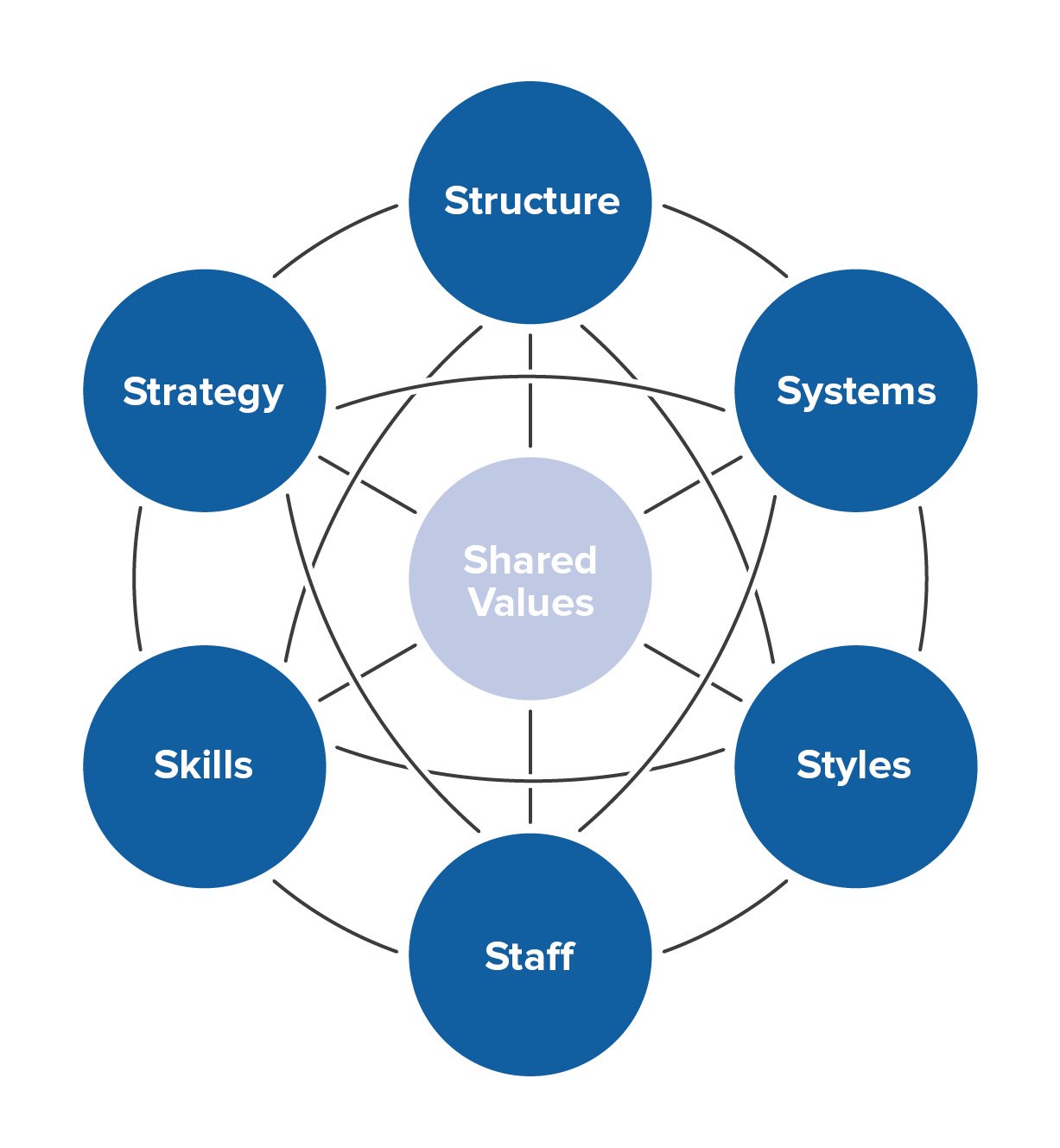
Great LEADERSHIP starts with your VISION using McKinsey7-S-Model to assess a company structure for leaders by Richard Gourlay

Challenges for Leaders Vision

Failing to validate and then alter a business model to reflect changes in the market towards the delivery of a vision. This is the single biggest single reason chief executives fail to succeed. 

Leaders have to carry people with them for their vision to be live. Poor communication skills are at the heart of why visions and therefore leaders fail to succeed. Leaders must be able to create, verbalise and rationalise to others their vision to generate buy-in and carry their senior people with them. Being able to visualise their vision and communicate it to a wide range of stakeholders often stalls or causes failure in strategy delivery.

For a vision to succeed leaders have to build relationships. This starts in developing trust in their future and develop a team culture all working towards that vision. The inability for leaders to invest in developing their vision often results in the lack of trust and development within the senior team.  This failure to develop leadership soft skills, is a major area leaders must invest in to improve their effectiveness as a leader.

Leadership is both Science and Art

Leadership is a balance between science and art. Creating a vision is often seen as an art, but for a vision to connect with senior stakeholders visions require a scientific rationale. It is the old adage we buy with the heart and justify with our head. A solid vision is both a visual message but one backed up with both direct and indirect evidence of that future state in which the leader’s vision sits. A successful vision pulls people together through shred valued values across the organisation what creates and sustains those values.

Great Leadership requires Communication Skills

The importance of being financial and operationally literate to the CEO role is always seen as core leadership skills. These hard skills are often key drivers of leadership assessment. Which is why so many CEO’s come from finance and operations leadership backgrounds. Today these competencies are seen as important for any CEO role.

In todays’ business environment CEO’s are being selected based upon having a demonstrated track record of delivering strategic vision. The ability to inspire others through delivering a strategic vision is now being seen as the most important track record for successful leadership.

Succession Planning 

The importance of succession and smooth transition is becoming more important element for successful leadership. Companies today are investing time and effort in succession planning. Well planned succession planning ensures long-term shareholder value and the ability of avoiding the football management culture of overnight change. Poor leadership choice often leads to cultural conflict and short-term reactionary thinking leads to rapid and unsustainable change. Both these mentalities damage the long-term sustainability of a successful business.  The leadership teams ability to develop successors who are able to support and follow through a vision is becoming an integral part of the CEO role.

Business leaders all recognise that talent management plans, including succession management have become essential for sustained performance in today’s organisations.

If you want to develop your company’s position then there needs to be a clear vision for it. Vitally answering the questions where it is going and why? If your are looking for some advice on developing your company, its marketing, its sustainable competitive advantage then contact us at Cowden.  Let us see how we can assist you, or read more about us in this blog or at Cowden.

Or learn how to plan your business successfully see our video to learn more:-  http://www.richardgourlay.com

Click below to follow us on other social media:-

Website – Linked in – Twitter – Facebook – Blog

Or buy the book on strategy here: Strategy The Leader’s Role 

Strategy The Leader's Role by Richard Gourlay

Cowden is a strategic planning and implementation business which enables customers to grow and develop their business.

Contact Richard Gourlay
Contact Richard Gourlay to discuss your needs.
Name
Email
Customers telephone number
How can I help you with your business or leadership skills?