SaaS Growth business leadership by Richard Gorulay

What makes A Successful SaaS Business

Successful SaaS Solutions Start with a Minimum Product Viability (MPV)

Achieving a successful SaaS Business starts not with a perfectly formed SaaS platform, but by achieving a Minimum Product Viability (MPV) SaaS platform. That is the essential first must have goal for any successful SaaS business. But an MPV SaaS solution is not just a working model: but one that delivers the real value proposition which your SaaS solution promises.

The ‘real SaaS MPV goal’ is not often fully understood as to what it must achieve to avoid pre-launch failure for SaaS businesses. Too often SaaS MPV’s are half hearted aspirational “nice to have features. Compared to a successful SaaS solution of ‘must have’s’ SaaS solutions. That’s what makes a successful SaaS business, they always start with a robust MPV.

Business leaders’ are often told that shifting to a SaaS model ‘build it and they will come mentality,” but they won’t come, if you don’t achieve a robust SaaS MPV. You won’t compete within your chosen market.  Just being an online SaaS product does not make your business achieve success. If the SaaS MPV does not actively compete, then it will not succeed. So MPV is often a misunderstood or omitted market entry goal. MPV means your software as a service actually wins target audience customers making you a player within the market. Once you get this right then you can look at your SaaS pricing model. 

Launching without a MPV

Too many companies start trading without achieving a clear MPV. They build it, launch their marketing and sales plan and start trading and hope. But their SaaS fails to deliver to their target audiences. Pressure on SaaS businesses is to get there quickly. That often leads to trials which do not convert. Channel partners do not actively resell, Uncertain customer acquisition plans and confused pipeline management. All resulting in SaaS metrics such as cost per customer acquisition continually increasing. That leads to high burn rates of cash and pressure on leaders to chase customers. Pressure to play catch-up replaces ensuring the SaaS delivers its fundamental goal, that of real tangible value to the customer.

The alternative risk in not looking to achieve a robust MPV is that effort, resources and personal energy are lost in developing the wrong elements of the SaaS business. Rushing to market, often means that the marketing and sales drivers forward leaving the core offering behind. This leads to over promising and a confused set of priorities. for the company. Resulting in leaders trying and patch together into a coherent product or service offering.

SaaS Require Robust MPV

SaaS MPV metrics must be clear. MPV must be a tangible goal with a viable product offering. If you take your service online is must do more than just exist. Now I am not saying it needs to be perfect. But a over-polishing a SaaS solution is one of those very dangerous assumptions we will come onto shortly, but simple migration of a product online is not a SaaS MPV.  

For Minimum Product Viability to be achieved, a SaaS solution must successfully compete within its market(s). It must win new customers for it to achieve MPV status. Too often the model of lower cost looks good on paper, especially to the accountant, investors and banks. Which is supported by competitor analysis and trend analysis but without any evidence of actually being able to win target segment customers.  

Don’t Hit and Hope with SaaS

The built and they will come mentality often leads to the knee jerk reaction from companies to offer discounts to customers to gain traction right from the start. The downside of that tactic is that the predicted customer revenue targets aren’t met if you give it away. Giving it away also means that customers do not value your SaaS offering resulting in:-

1. Poor customer quality

2. Low engagement and low retention rates.

3. Poor product development which damages the core SaaS product.

4. False success metrics driving poor service and innovation

5. A SaaS business with short term mindset

The other major challenge of giving it away on day one to gain traction is that once the opening price perception is set it is difficult to reset. Initial target audiences are typically early adopters who usually are your target premium customers, they expect certain valuable features within the MPV that tie them in, which if not immediately available mean that they will abandon the SaaS solution. It is also difficult to recover your market or premium market price unless you have large marketing budget to support the opening offer discount.        

Measuring MPV requires leaders to not only check it works (and that is never a given with IT) but also that it achieves MPV as an offering. Does it do what it needs to do for the customer.? Does it meet the complete customer requirement of the value proposition? So do not just focus on the pure IT but on the whole value proposition to measure the MPV status. Test it with pilot groups, measure not only it looks good, but does it replace what they were doing? If not it needs to do more.

Over-polishing your SaaS MPV

I have worked with several SaaS start-ups and migration SaaS brands who face the eternal problem of over polishing their MPV. Failing to set a MPV goal with a timeline means that many companies keep playing and tinkering with their SaaS product rather than get it out there.

The challenge is that everyone has thoughts, features and layouts they want to see, so the more people involved the more the pull and push from 3rd parties to meet their expectations or perceptions. The nature of every increasing committees is to tinker and therefore delay. Continuing to over-polish is a major issue for many SaaS businesses. They ask too many people to review it and each has a view, but continual reviews and tweaks delay the acid test ill it work in teh real world.

Everyone has an opinion and no matter how valuable it is the MPV goal must define the MINIMUM, not the optimum or the ideally would like. These should be in secondary releases onwards as upgrades and add-ons. An MPV must to have a launch deadline in place with clarity of what that SaaS will deliver and how it will be upgraded over time to meet specific needs. A soft Beta test launch to a target audience will test and validate the MPV objective, which if you have followed the classic MPV creation model (below) will enable you to get to market with a credible SaaS solution.

SaaS Business model

What makes a successful MPV? One that delivers the SaaS value propositions’ core elements. When entrepreneurs or leaderships teams are building their SaaS businesses model they must start by thinking through what are the core elements we MUST HAVE rather than those we would LIKE to HAVE. Those core elements must engage with their target audiences both directly and through whatever channels to market they intend to operate with or through.

That MPV, what you go to market with to prove the concept and launch your business with has to contain the MUST HAVE‘s that both challenge and disrupt the market your SaaS model is entering, if it is to succeed.

So the MPV must be robust, not aspirational. It must do deliver the core value proposition, not be full of we will do this at a later stage. The phrase “You never get a second chance to make a great first impression.” Defines the need for a robust SaaS solution MPV within any market. If it is not robust in delivering those core value proposition elements then it won’t challenge or disrupt the existing players whether they be physical or SaaS competitors. Lets look at how to create a Robust MPV.

Create A Successful SaaS Business

1a. Firstly identify the success criteria that will indicate whether or not the SaaS solution will be successful

1b. Then identify the business needs of the sector today and over the long-term.

2a. Map out the customer / user journey(s)

2b. Then segment the core user groups (called the actors)

2c. Clarify the journey end point (end goal)

2d. Then mark all actions the user must take to meet that end goal, and then simplify them as much as possible, less is more.

3a. Write down the action the user completes when using the product

3b. Write down the pain points for each action

3c. Write down the gains for each action

3d. Summarise the pains and gains into opportunity statements

3e. Use “How might we” statements or a similar method to summarise the pains and gains you have identified, prioritise and

4a. Use opportunity statements to finalise your core “must have” features and ensure they are built into a coherent MPV model.

4b. Provide a breakdown of the features to include in the product roadmap, identifying each feature element.

4c. Use a prioritisation matrix (or similar method) to prioritise features creating a complete MPV customer journey to build and launch with.

4d. Identify other features to be launched as 2nd phase onwards and use target customer audience or beta test launch feedback to validate these feature in subsequent launches.

4e. Identify Key SaaS metrics including UX, channel partner and disputer effect metrics to measure your MPV launch with.

Successful SaaS

Get your MPV wrong and it is difficult to make a comeback. Understanding your core audience (it may not be big but it must be defined and reachable). Many SaaS MPV are done below the radar, with soft launches to target audiences either directly or through selected or exclusive channel partners to provide validity of model and ensure MPV has been achieved.

Going big too soon is often appealing but rarely successful. Think about achieving viability then scaleability with a proven model to solve a tangible issue for a target audience and you are more likely to succeed. Research your target audiences’ specific needs and plan points and ensure that your MPV focuses on delivering the results they need, rather than trying to do too much. Add value and then keep on adding more value is what makes a successful MPV for a SaaS business.

Richard Gourlay

Richard works with SaaS entrepreneurs in developing their SaaS solutions, to learn more and contact Richard Gourlay click here now

Great brand by Richard Gourlay leadership and strategy

What makes a great BRAND

What makes a great BRAND?

Despite what marketing people passionately believe most people don’t think about brands, they just get on with their lives. The coffee they buy, the supermarket they go to and petrol station they visit happen almost by accident. In Britain today we are too busy to think through these everyday inconsequential purchases, focused on saving time, not forgetting something or rushing from place to place on a tight deadline. So do brands matter as much as they used to and if so why and how?  Brands matter where consumers can value them.  In today’s wealthy world every product or service perceives itself as a brand, even if it is just a label. So what makes a great brand?

Consumer Choice 

Let’s start with the basics, the consumer has choices. Endless choices if they choose to use them. But in many everyday cases as in my examples above, the consumer sacrifices those choices for simple expedience. The inability to see (or value) brand differentiation, between Starbucks and Costa, between Tesco and Morrisons between BP and Shell, and yet they each fight for space in consumers minds through tiny differences which if we stop and think about do actually exist and we the consumer do actively value.

So much more than First Impressions 

So in today’s Britain, what is important about a brand? Is it the halo effect, the first impression, like the smile on the front of a car or is it something more, something deeper and more tangible? Ask the owners of Sunny D (the 90’s orange juice lookalike) and you will find that the halo effect does not last if your brand is not true to itself and to its consumers. Customers have to believe in a brand, it must tell the truth, be transparent and honest if it is to be successful. Gerald Ratner (former MD of Ratners the jewellers who said about his products “because it’s total crap”) also found out that in today’s world everyone must truly believe in the brand, not just the marketing department but the whole company has to believe it and most importantly practice the brands beliefs.

Clear Brand Strategy 

Being clear and precise is also important in the company’s messages for a brand to succeed, a strong undiluted brand message must enthuse internally but must also consistently connect with customers through touch points, look at Innocent, Dorset Cereals or Apple as classic examples of touch point. They also demonstrate a clear story delivered with passion about who they are what they do and why they matter. This focused and consistent message is not just a marketing message but an ingrained set of values which consumers buy into with passion. These brands not only position themselves as premium players in their fields and earn more but they also continuously find new ways to spread their key messages to customers, they have a clear brand strategy to achieve it.

Everyone Lives the Brand

Another vital aspect of any brand success is that the people within that brand demonstrate what they preach, they live that lifestyle, support that brand and contribute to its success. It is their lifestyle, it is a part of the way they and their brand do business.

Great brands go beyond the brand to understand its real value to existing customers but also to tomorrow’s customers.  Whether it is a family run local shop or a global supermarket chain great brands position themselves so they develop and hold a market position to develop long-term success.

Vision and Purpose

Great brands create, sustain and evangelise a culture which supports and drives their brand. Creating a culture which underpins an organisations vision and purpose is a key prerequisite for ensuring sustainability of a great brand. Sustainability of a vision can only be achieved if the organisation is supported by an underlying culture which fits with the brands ethos.

Great brands can only transpose from the innovative visionary founder if they create a supportive culture to sustain the brand. An effective and appropriate culture is one which supports the brand and ensures it is can sustain its market position over time.  Great brands sustain themselves through a great culture.

The culture of a brand, otherwise seen as the handwriting of the organisation, enables sustainability of the brand over time. Culture today matters from how people work together through to acquisition of appropriate talent. The right people are drawn to a brand they aspire to be part. Business partners focus on brands with likeminded cultures andante to be part of a great brand. In the exact same way customers aspire to be associated with a great brand.

Great Brands are not Labels

Great brands drive markets. By challenging them through innovation and changing perceptions. Labels on the other hand feed off brands by picking of successful innovations for downstream ‘me too’ market following customers. Great brands invest high proportions of their resources in driving markets forward, through innovative products and services. Great brands are seen to out invest other players more double the the market average.

Creating innovative pipeline cultures thinking long-term make positions rather than short-term tactical single product successes. Labels focus on creating  market winning season products, they act as followers often being low-cost alternatives to the brand leaders in any sector.  Brands focus on the longterm innovation which shift the paradigm of relationship with the customer through the brand.

Great Brands Add Value

Great brands also develop their own uniqueness, not just the product or service but the whole package is how we do it around here. There needs to be not only consistency but the brand hand writing and value on how they do it. The best brands always develop singular simple signals for customers, cutting through jargon to create clarity without patronisation.

For brands to succeed in today’s global markets these golden rules have never been more important as consumers have never had so much information, but if you follow these simple rules of brand success you can develop and maintain a great brand.

Looking for Advice  

If you want to develop your company’s brand and are looking for some advice on developing your company, its marketing, its sustainable competitive advantage then contact us at Cowden  to see how we can assist you, or read more about us in this blog or at Cowden

Click below to follow Richard Gourlay on other social media:-

Website – Linked in – Twitter – Facebook – Blog

Cowden Consulting is a strategic planning and implementation business which works in partnership with customers to grow and develop their business, contact us to learn more.

Posted 1st December 2011 by Richard Gourlay

Location: Old Glenstocken, Colvend, Stewarty of Kirkcudbright, Galloway

Labels: brand brand identity brand strategy brand strength branding business success marketing strategy strategic direction strategy sustainable companies values vision

SaaS Business make you own path by Richard Gourlay

How Steve Jobs changed the World

Strategy: How Steve Jobs changes teh world by Richard Gourlay

Apple’s founder and talisman, Steve Jobs has finally had to step down from running the world’s most successful company.  It is probably overdue that the world recognises this brilliant strategist who changed the world.  Here’s how Steve Jobs changed the world.

Had Steve Jobs just set-up Apple he would have gone down in history as a great inventor.  But to have done it twice over with the same company, while in the process creating the world’s biggest company, surely makes him the greatest ever.  Possibly his most important contribution was that he created markets and then the best products possible for those new markets.  Steve Jobs understood that the technology needed to work for customers, rather than expect people to work the technology.   

A Brilliant Visionary

As a brilliant businessman and strategist, he more importantly created world class products and ran the company that delivered those products to market. Most superb inventors just invent, and most great directors’ focus on leading. To do both simultaneously to such a high standard is an outstanding achievement.

Steve Jobs is so unusual because he understands that great technology does not sell itself. That to have great technology you have to be passionate not only about what you produce, but also about the world in which your products exist.

Steve Jobs a brief history

  • 1976 started Apple with Stephen Wozniak to make and sell printed circuit boards
  • 1978 launched  a new disc drive which made the money to invest in whole computers
  • Launched the revolutionary Macintosh computer in 1984
  • Ousted from Apple in 1985 and returned after creating NeXT in 1996 which Apple bought
  • Created Pixar with $5 billion in box-office sales, sold for $7.4 to Disney in 1996
  • Created the i-generation with more to come such as iCloud and entering the TV market

While to many who did not understand his holistic strategy, they looked for and saw flaws. They tried to stab the ego and even removed him from his own company (to play safe with what he had produced as a single new product).  He played the long game recognising that the world would not be changed overnight. This was his strategic master-stoke.  He got the timing right by understanding the big picture and knowing when to strike.

A Difficult Man To Work With

He has been described by those who have worked with him as wilful, irascible, temperamental and stubborn, to name a few.  But can anyone do so much without at least those characteristics to change the world?  Other words, which people often use to describe him, include perfectionist, insistent and mesmerising. These words are the ones which the world will remember for. These drove him and describe how he has achieved such global success.

As a manager he had difficult dealings with many people at all levels, from investors and employees.  Management and human relationships was not Steve Jobs’ forte. These difficulties made him human. They were simple human failings which showed he was not perfect, but not issues which limited his vision or aspirations.

Steve Jobs Stanford Address

In his Stanford addresss (click here to see it here) in 2005 he explained what made him, drove him and continued to motivate him to become the person he was. This address is one of the few times he spoke of the huge success for which the world will remember him for.

Steve Jobs changed the world.

He saw a world revolution in technology before anyone else, and saw how he could drive that change. Great strategic thinking not only thinking about change, but also the impact of that change will have. That’s what makes him simply the best. Other owners and directors were working on improving their share price, or becoming number one with their new product. Focusing on the today, this month’s or this years priorities, not on changing the world. Steve Jobs looked beyond the single product to look at the whole picture of what a new world might look like.

Steve Jobs drove Apple to rethink the world and in doing so became its biggest player. His line in recruiting John Sculley from Pepsi “Do you want to sell sugar water for the rest of your life or do you want to come with me and change the world”. This sums up his strategic brilliance.

Steve Jobs Visionary

Evidence of this brilliant approach comes throughout his career. From using Vangelis’ Chariots of Fire music to launch the Macintosh, through to his unforgettable iPod launch where with a huge back screen shot he casually produced it from the back pocket of his jeans! Steve Jobs has learnt how to successfully engage with audiences. Every product is meticulously planned with product lined up to two years in advance, with innovative marketing from start to finish.

Moving From Technology to Retail

From a business which started out a just selling technology, it is now seen as having the best retail environment. That retail environment created places people actually want to visit.  Apple shops where the focus is on excellence, not on pedalling technology cheaper than the next retailer.

Steve Jobs has always had an eye for detail. His artistic flare turned geeky boxes into works of art. Steve want on a calligraphy course which led him to have a non standard font, Apple Garamond created rather than traditional New Roman Times font. Something he goaded Microsoft about at a high school speech some years later. That attention to detail is what demonstrated his perfectionist approach and left the competitors looking and feeling like they were in the dark ages.

Think Different Campaign

Apple’s “Think different” strategy has worked so well since 1997 because it touched people who felt there was no alternative to Bill Gates’ Microsoft monopoly of software. Think Different also drove change for both the 50,000 Apple employees and allowing his strategy to infect and spread globally.  It was not only technical people who bought into Macs but a whole new generation of users, who found that there was a credible alternative that did more than just be a glorified typewriter.

While Apple was never one man.  Steve Jobs legacy will be difficult to estimate for many years to come as the world’s most successful businessman. The old adage, it is not what one has done that counts but what one leaves to grow, that is the measure of a man’s success. It will take time for the world to see his true legacy, but the following puts some numbers behind this success.

Since Steve Jobs comeback in 1997 Apple has sold:-

  • 26 million iPhones
  • 60 million computers 
  • 200 million iPods
  • 1 billion iTunes songs   

Apple is currently valued at $356 billion ($2 Billion ahead of Exxon). Making it the largest company in the world. Last quarter alone Apple profits more than doubled to $7.3 billion. Sales rose by 82% to $28.6 billion by selling 20 million iPhones, 9 million iPads, 8 million iPods and 4 million Mac computers.

Steve Jobs announcement of his retirement wiped $17 billion *(5%) from its market share. But over his leadership he has increased its share value by 9000% since 1997.

Leadership Development by Richard Gourlay

Great LEADERSHIP starts with your VISION

Great LEADERSHIP starts with your VISION 

Having a Vision for your business is the most important leadership trait for a successful leader to have. For leaders to lead they must have a strategic vision for their business. A clear future state they want to achieve. One which provides not only an optimum place within their market they want to be; but one which inspires, motivates and drives the organisation to achieve. Heres is why Great leadership starts with your vision.

Great leaders may be charismatic, they may even be likeable, but for them to be successful they must be able to communicate and inspire others through their vision. A vision is a future place within tomorrow’s market.

Leadership Vision

Leader’s must create a vision which is not only aspirational for themselves but motivational for the all stakeholders.

A recent survey of 1,439 chief executives and senior HR people from 707 organizations across the globe, found that the outstanding trait of successful leadership is the ability to create and communicate a VISION.

This is the single most important characteristic for success.  Amongst those interviewed a clear vision scored an impressive 92% amongst such high level people in business. This demonstrates just how important a characteristic this is in creating a successful leader.

Vision to make change in business by Richard Gourlay in this article: Great LEADERSHIP starts with your VISION


“Without a clear vision no leader can succeed today in business”

Creating a VISION

Creating a vision is not easy. Leaders are busy people fighting to keep their business on track, dealing with day-to-day issues and making decisions based upon facts and figures. That last point is therefore a real challenge for leaders in developing a vision. This is because there are no facts and figures about the future. The future, by definition is unknown. Instead leaders must rely upon a range of forecasting tools, from gut feel or by benchmarking agianst others, to develop their vision of what the future might look like.

Each of these options in forecasting the future are fraught with danger and risk. Both in terms of making decisions based upon inaccurate perceptions or the damage to their credibility as a leader. Following others through benchmarking is always the safest option for leaders. But this limits leaders to be a follower within any market sector, rather than to lead it from the front in their sector.

Great Leadership deals with Change

For leaders to lead, they must be able to deal with change. Change happens in-perceivably until it is obvious. Every day we grow older but it is only when we look back we see how we have aged. The same is true for a business in any market. Even when change is driven by disruptive new entrants, the change that enables new players to enter a market is caused by subtle sometimes in-perceptivable changes within a market. Change is everything and is happening all the time.  Subtle innocuous and minor alterations in a market can become future key drivers of change which create new opportunities are areas which leaders need to keep aware of and proactively respond too.

Change is the only constant in any business. The market is always moving either through Macro market factors or through Micro market factors. Good leaders need to be continually scanning and monitoring both and assessing likely positive and negative  impacts upon their business, their customers and their channels to market and value perceptions of their brand.

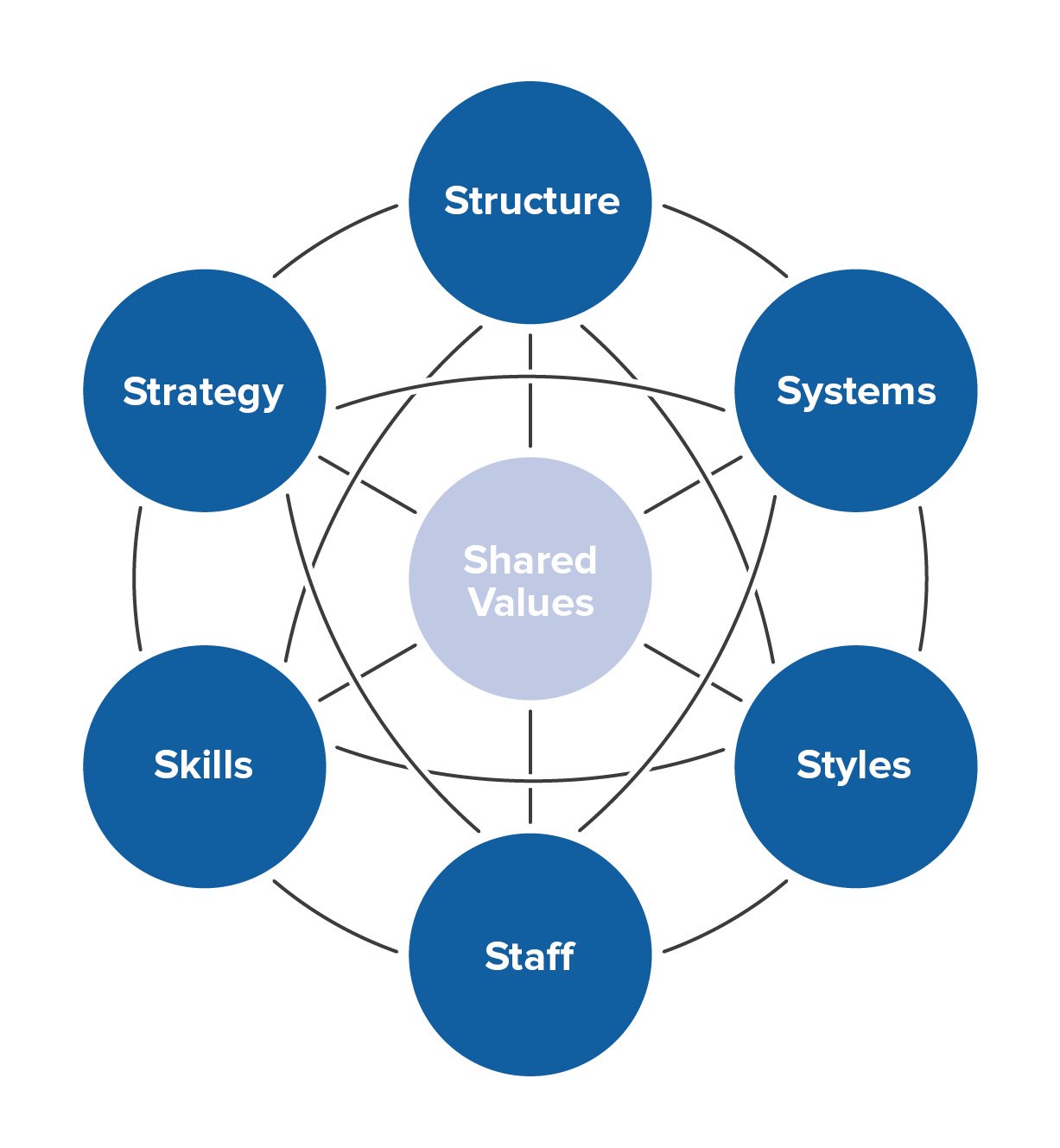
Great LEADERSHIP starts with your VISION using McKinsey7-S-Model to assess a company structure for leaders by Richard Gourlay

Challenges for Leaders Vision

Failing to validate and then alter a business model to reflect changes in the market towards the delivery of a vision. This is the single biggest single reason chief executives fail to succeed. 

Leaders have to carry people with them for their vision to be live. Poor communication skills are at the heart of why visions and therefore leaders fail to succeed. Leaders must be able to create, verbalise and rationalise to others their vision to generate buy-in and carry their senior people with them. Being able to visualise their vision and communicate it to a wide range of stakeholders often stalls or causes failure in strategy delivery.

For a vision to succeed leaders have to build relationships. This starts in developing trust in their future and develop a team culture all working towards that vision. The inability for leaders to invest in developing their vision often results in the lack of trust and development within the senior team.  This failure to develop leadership soft skills, is a major area leaders must invest in to improve their effectiveness as a leader.

Leadership is both Science and Art

Leadership is a balance between science and art. Creating a vision is often seen as an art, but for a vision to connect with senior stakeholders visions require a scientific rationale. It is the old adage we buy with the heart and justify with our head. A solid vision is both a visual message but one backed up with both direct and indirect evidence of that future state in which the leader’s vision sits. A successful vision pulls people together through shred valued values across the organisation what creates and sustains those values.

Great Leadership requires Communication Skills

The importance of being financial and operationally literate to the CEO role is always seen as core leadership skills. These hard skills are often key drivers of leadership assessment. Which is why so many CEO’s come from finance and operations leadership backgrounds. Today these competencies are seen as important for any CEO role.

In todays’ business environment CEO’s are being selected based upon having a demonstrated track record of delivering strategic vision. The ability to inspire others through delivering a strategic vision is now being seen as the most important track record for successful leadership.

Succession Planning 

The importance of succession and smooth transition is becoming more important element for successful leadership. Companies today are investing time and effort in succession planning. Well planned succession planning ensures long-term shareholder value and the ability of avoiding the football management culture of overnight change. Poor leadership choice often leads to cultural conflict and short-term reactionary thinking leads to rapid and unsustainable change. Both these mentalities damage the long-term sustainability of a successful business.  The leadership teams ability to develop successors who are able to support and follow through a vision is becoming an integral part of the CEO role.

Business leaders all recognise that talent management plans, including succession management have become essential for sustained performance in today’s organisations.

If you want to develop your company’s position then there needs to be a clear vision for it. Vitally answering the questions where it is going and why? If your are looking for some advice on developing your company, its marketing, its sustainable competitive advantage then contact us at Cowden.  Let us see how we can assist you, or read more about us in this blog or at Cowden.

Or learn how to plan your business successfully see our video to learn more:-  http://www.richardgourlay.com

Click below to follow us on other social media:-

Website – Linked in – Twitter – Facebook – Blog

Or buy the book on strategy here: Strategy The Leader’s Role 

Strategy The Leader's Role by Richard Gourlay

Cowden is a strategic planning and implementation business which enables customers to grow and develop their business.

Contact Richard Gourlay
Contact Richard Gourlay to discuss your needs.
Name
Email
Customers telephone number
How can I help you with your business or leadership skills?