

Mentorship is about providing support, guidance and advice. It’s about connecting with an experienced professional who accelerates your growth through structured support, accountability, guidance, and real-time advice, That is how mentoring works in supporting people succeed.
Whether you’re looking to break through your current ceiling, push past your barriers, or build a company from scratch, having the right mentor provides you with someone who has already walked the path you’re on and can help you avoid the mistakes they made along the way. For mentoring to work effectively for you as a mentee, it requires a desire to develop your skills while utilising a mentor to guide you in your role and improve your contributions. How mentoring works is by supporting mentees to grow through active support, here’s how.
I’ve been a mentor since 2003. In that time, I’ve supported people as they grow and develop in their roles, and their business through adversity and challenges. I have helped them adapt and change to meet those challenges. Here’s how to choose the right mentor for you.
Making Mentoring Work
This article covers the thinking you should go through behind finding an effective mentor. How different types of mentors compare, what mentoring sessions actually look like. Ultimately, how to evaluate whether mentoring is worth your time and money. By the end, you’ll have a clear picture of what to look for and what to avoid.
What is mentoring?
- Mentoring is an ongoing relationship with an experienced guide, not a one-time call or course
- The best mentoring happens when you are well matched, based on goals, communication style, and industry experience.
- Expect to invest between £300 and £750 per month for quality mentorship packages, from monthly stand-alone support to ongoing weekly packages.
- Pick a mentor that works for you, a vetted mentorsme mentor, providing flexible format options (face-to-face, Teams meetings, and calls), and action-plan outcomes.
- Most people see measurable results within 3-6 months, but only if they come prepared with specific goals!
How Mentoring Works
A mentor solves the three biggest problems professionals face when trying to grow: isolation, decision fatigue, and blind spots you can’t see on your own.
While many business owners start of picking up tips and ideas from a variety of general sources. They often find it frustrating and fruitless. That’s because general advice doesn’t account for your specific situation, your industry, your company culture, your strengths, your weaknesses. A mentor who knows your story can give you the context-specific feedback that generic resources never will.
Short term coaching, quick generic courses, provide motivate and shared support. The motivation in those programmes can be highly valuable. But they vanished the moment you needed them most. That gap is why mentors like myself exist. I watched peers spend money on generic feel-good courses. The courses ended, the mentors disappeared, and people were left alone right when they needed guidance most.
Why is having a mentor important for professional development?
Because growth doesn’t happen in a vacuum. A 2019 study from the Association for Talent Development found that 75% of executives credit their mentors with helping them achieve success within their roles. The Return On Investment (ROI) isn’t abstract. It shows up in rational analysis; better thinking, and better decision-making, better results.
But here’s where people get tripped up. Not every mentoring programme delivers results, and when mentoring isn’t delivering, the problem usually falls into one of three categories. Either the mentor-mentee match was poor, the mentee didn’t come with clear goals, or the programme structure didn’t support ongoing accountability.
Mentoring vs Coaching
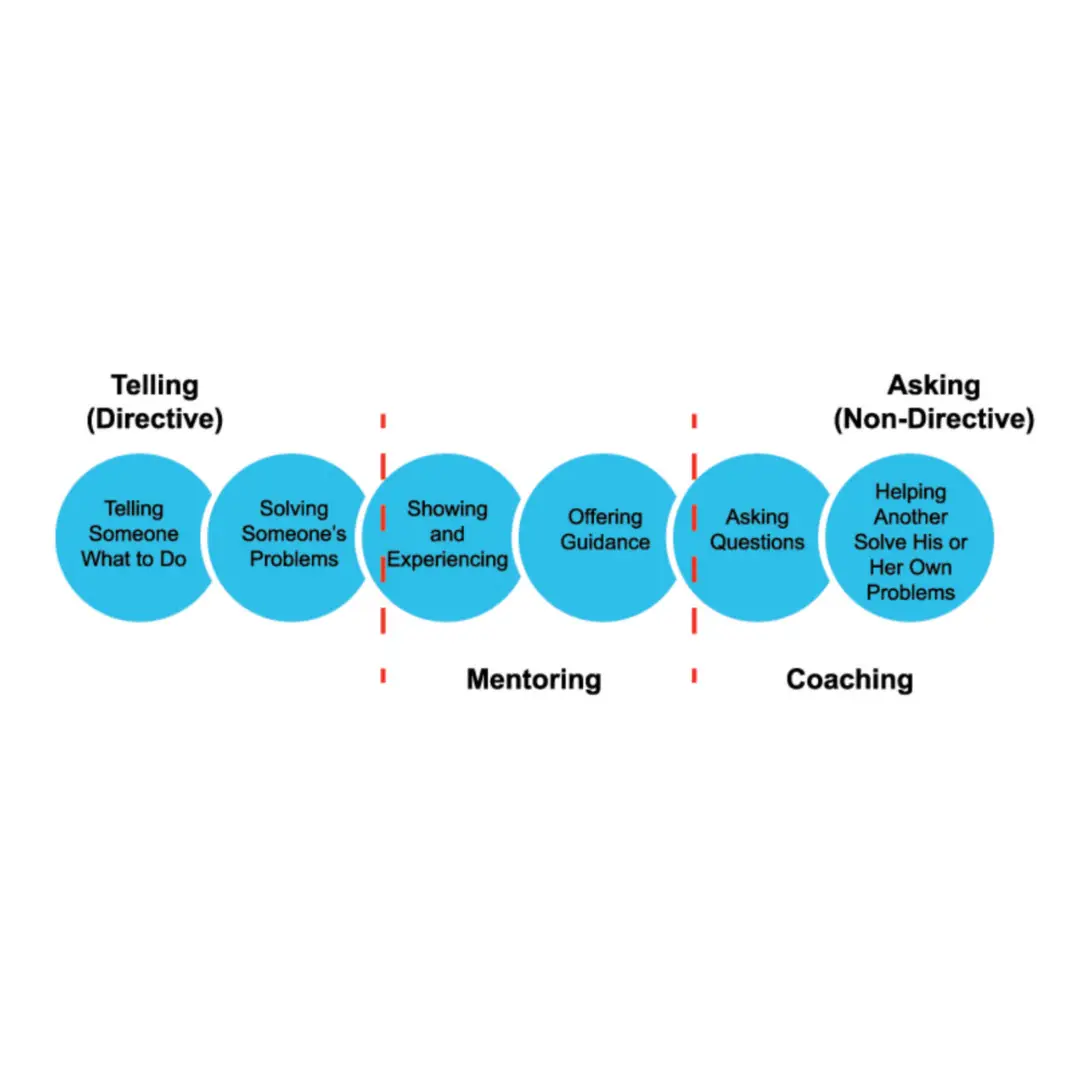
People often ask whether mentorship or coaching is better. The honest answer: they serve different purposes, and the lines are blurry. A coach typically follows a structured methodology and works toward predefined outcomes over a set number of sessions.
They are solving a single tangible problem. A skill need. A mentor draws from personal experience, adapts to your evolving needs, and builds a relationship that grows with you over time.
For most professionals looking for a wide range of business support, mentorship is the better fit because your challenges change over time, that’s how mentoring works.
The question you have in month one won’t be the question you have in month six. A good mentor accounts for that evolution. An average mentoring duration is over 12 months. Long enough for your mentor to understand your full context and adjust their guidance as your situation shifts.
Online mentorship vs In-person
Online mentorship programmes have a clear advantage for most professionals: you can work with the best person for your specific challenge, regardless of geography. In-person mentorship has its strengths, body language, rapport built over coffee. But, travel time, meeting location, and actual mentoring support time are now often better managed online.
What matters most is clear thinking time. That delivers real tangible outcomes that can be supported with an action plan that is then acted upon. That is when a mentor is making a real difference to a mentee, that’s how mentoring works.
How Mentoring Works: What to expect from mentoring sessions
Your sessions will typically combine live conversations (Teams call, usually 30-120 minutes) with potential check-ins between meetings, covering whatever matters most to your goals right now.
There’s no single template that works for everyone, and that’s actually the point of mentoring. But understanding what a mentor does and what they don’t do helps you get the most out of the relationship.
A good mentor will look to cover recap on progress made against goals, discuss your current thinking on key topics and set the landscape for the new challenges.
The roles your Mentor plays in supporting you
A mentor plays many roles: “the 7 roles of a mentor,” and while the exact labels do vary, the functions are consistent. Your mentor acts as a teacher when you need knowledge. A coach when you need accountability. An adviser when you need a decision framework. A connector when you need introductions. An advocate when you need someone in your corner. A sounding board when you need to think out loud. A role model whose career path you can learn from.
The best mentors all share a common trait: they ask more than they tell in early sessions. They’re diagnosing, not prescribing.
The mentors who struggle, will jump to offer advice before understanding the full picture. When you’re evaluating a mentor notice whether your potential mentor spends the first session listening or lecturing. That tells you everything.
Mentoring models that really matter
You’ll find dozens of mentoring models online; the most common ones are:
GROW model, (Goals, Reality, Options, Will) sets the mentoring framework
5 C’s (Competence, Confidence, Connection, Character, Compassion),
3 C’s (Clarity, Communication, Commitment),
4 P’s (Purpose, Preparation, Participation, Plan),
3 A’s (Availability, Active Listening, Analysis).
They all point to the same core concept. Rather than memorising models, focus on what they share. Effective mentorship has three ingredients.
- Clear goals that both people understand.
2. Open and honest communication.
3. Mutual commitment to the process.
If those three things are present, the relationship works. If any one is missing, it won’t matter how fancy the framework is.
Good mentoring matches share three things: aligned communication styles, realistic expectations, and chemistry on the first call.
Expertise match matters less than most people think. A senior mentor who communicates well and genuinely cares about your growth will outperform an industry celebrity who gives you generic advice.
How mentoring works : being mentored
Come to every session with specific questions or challenges. The mentees who drift into calls without an agenda leave disappointed. The ones who show up with “here’s what happened this week, here’s where I’m stuck, here’s what I’ve tried” get ten times the value. Secondly the follow-up accountability: what new have you tried to make a difference? Stretching mentees to try something different is vital for getting the most out of mentoring, that’s how mentoring works.
Set goals early. Within your first two sessions. You and your mentor should agree on what success looks like within the first 3 months. Write them down. Revisit it monthly. Successful mentoring follows a clear precise pattern. They start with internal clarity (what do I want?). Move to skill mapping (what gaps exist?), and only then, go external (networking, applications). Most people start with step three and wonder why they’re stuck.
Between sessions, use touch points to support you with check-ins on key challenges. Mentoring today usually includes messaging touch points between calls. Meaning you don’t have to wait to ask a quick question about a job offer or a difficult conversation without mentoring support. That ongoing thread is where some of the best mentoring happens.
How to choose the right mentor
Start by defining what you need in support and advice. Then evaluate the mentors ability to support you against those specific requirements, not their marketing promises, nor their name dropping, or qualifications. When you are selecting a mentor, look for the person who is focused on you.
What to look for in a professional mentor
The criteria that matter most when choosing a mentor include: mentor quality, programme flexibility, and how easy it is to leave if things don’t work out.
Mentor quality means verified experience, not just impressive titles. Look for mentors who take time to get to know you, track records of having worked as mentors with the same types of mentees over significant periods of time. Another useful factor is domain expertise that matches your specific goals.
Mentor flexibility means you can adapt the cadence, format, and focus as your needs change. A good mentorship programme doesn’t lock you into a rigid schedule.
Exit options matter because not every match works. The ability to cancel anytime, no long-term commitment, no penalty that protects you from staying in a relationship that isn’t delivering.
Red flags to watch for
Avoid mentors that require long contracts before you’ve even met.
Avoid mentors who talk more about themselves than about you in your first conversation.
Always be wary of mentors that promise specific results; mentorship is collaborative, not transactional.
Avoid a mentor who just wants to just chat. If there is no development, no actions and outcome ownership, then you will not be stretched to achieving your goals.
How to know if your mentor is the wrong fit?
If you dread your sessions, if your mentor consistently cancels or shows up unprepared, or if their advice feels generic rather than tailored to your situation. You probably have a poor fit.
A mentor should challenge your thinking, not just agree with you on everything. If they do not listen and understand your thinking process, then it is unlikely they will be a good fit with you.
Finally, a contrast is a good thing. Diversity in backgrounds, thinking and perceptions, while it may seem difficult at first often creates the strongest mentoring relationship. While it is important to get on with your mentor. Don’t expect them to be your best friend. A good mentor gets along but also pushes you forward. That tension, challenge and stretch, is what a successful mentor should do.
How long should a mentorship last
Most mentees start seeing tangible results within 3-6 months, but the most successful relationships really start to built around the 8 month point. Mentoring works as the relationship builds. It takes time to establish the relationship and develop the trust between the mentor and the mentee.
The length depends on your goals. If you’re preparing for a specific goal, a focused 2–3-month engagement might be enough. If you’re building a company or transitioning into an entirely new career, plan for 6-12 months, as a first stage.
Mentoring is an Investment
Quality mentorship typically costs between £300 and £750 per month, depending on the level of support you require.
Those numbers might seem high if you’ve never paid for mentorship before. But consider what you’re comparing it to. A single career mistake, taking on the wrong contract or staff member. Missing a negotiation opportunity, or building the wrong product, can cost you tens of thousands of pounds in lost income or wasted time. A mentor who helps you avoid even one of those mistakes pays for themselves many times over.
What affects the cost
Mentor experience and specialisation drive pricing more than anything else.
A mentor with 5 years of experience in HR will charge less than a former entrepreneur who’s scaled three companies. Both can be excellent. The right choice depends on where you are in your career.
The other factors in mentoring costs are what type of mentoring support you require. A fixed single touch monthly session, compared to a flexible multi touch monthly support, with action plans, text / WhatsApp support and additional support calls will cost more, but will deliver significantly more value.
A great mentor can be like having an extra director onboard within your company, but at. fraction of the cost.
Evaluating the value of Mentoring
The right question isn’t “how much does mentorship cost?” It’s “what’s the cost of staying where you are today?” If you’re feeling locked in without guidance, consider what another 6-12 months of spinning your hamster wheels is worth. Set yourself a clear goal and measure the investment you make against the progress you make.
Like to know more about how mentoring works? Then get n touch with me today.
No responses yet